Columbus State University News
Directing change: How alumni Richard and Nicholas Sostillio are scripting the future of theatre
July 13, 2026
For many theatre students, the bright lights of Broadway are the ultimate goal. But for Columbus State University alumni Richard Frazier-Sostillio ’11 and Nicholas Sostillio ’12, ’21, the most important stage isn’t in New York City—it’s the one in the classroom. A powerhouse couple in the performing arts world, they have reached the upper echelons of theatre education leadership, demonstrating that the foundation built at CSU can support an arts education legacy.
Richard and Nicholas both credit their theatre education at Columbus State as the catalyst for their careers. While the university’s Department of Theatre & Dance is renowned for its rigorous training, it was their opportunity to lead and build relationships that made the biggest impact on the pair.
“There were many opportunities to lead, and those opportunities just multiplied as we continued our studies,” Richard recalled, citing examples like serving as tour manager for the Theatre for Youth Tour, associate directing alongside faculty and serving as president of the Alpha Psi Omega National Theatre Honor Society.
“In our classes, we learned a lot of theatre hard skills, but it was those soft skills—like communicating, collaboration and building relationships—that have also been part of our success,” Nicholas added. “The concepts of relationships and community, within Columbus State and the city of Columbus as a whole, were so prevalent that they would become the foundation for how we operate as people later in life.”
Those personal bonds, particularly with departmental faculty, have remained strong—even 15 years after they both completed their undergraduate degrees in theatre education.
“[As students], we had our teachers and mentors, and those people have continued to be our teachers and mentors, but they’ve grown over the years into great friends and colleagues,” Richard said. “They’re such a huge cornerstone of who we are—they’ve become an extension of our family.”
Taking center-stage leadership roles
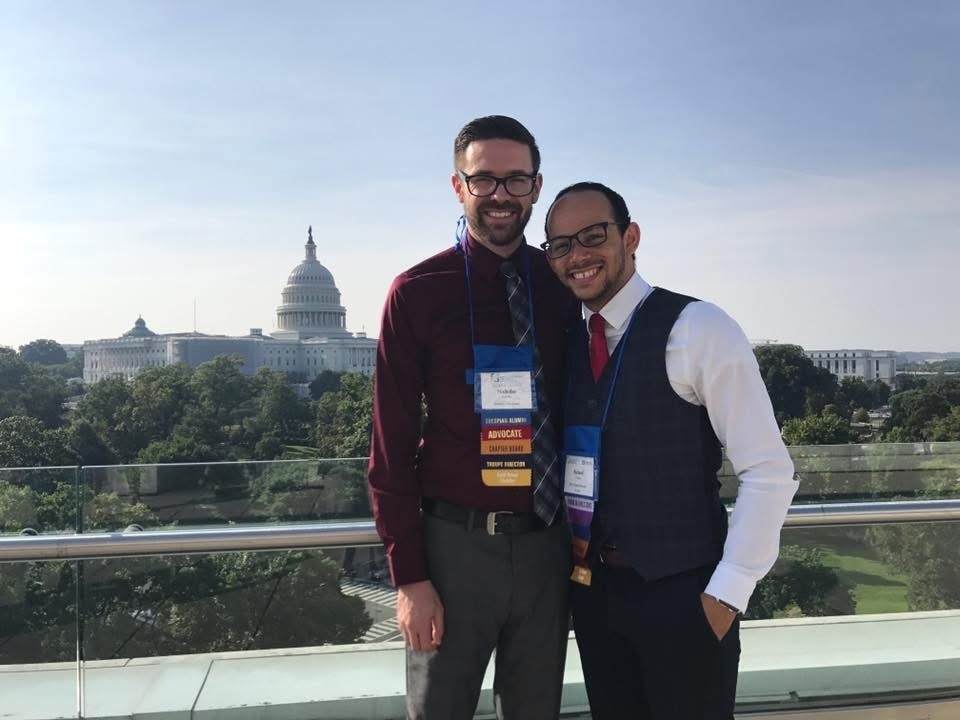
 For Richard (pictured), that foundation has supported a historic rise. In 2025, he
started his current role as president of the board of the Educational Theatre Association, an international nonprofit with 47 chapters worldwide that supports theatre students
and educators. It is also the parent organization of the International Thespian Society,
a student honor society that has inducted more than 2.5 million Thespians since 1929.
Notably, Richard is the first African American president in the organization’s history—a
milestone that emphasizes his commitment to representation and service.
For Richard (pictured), that foundation has supported a historic rise. In 2025, he
started his current role as president of the board of the Educational Theatre Association, an international nonprofit with 47 chapters worldwide that supports theatre students
and educators. It is also the parent organization of the International Thespian Society,
a student honor society that has inducted more than 2.5 million Thespians since 1929.
Notably, Richard is the first African American president in the organization’s history—a
milestone that emphasizes his commitment to representation and service.
While Richard concentrates on the national scene, Nicholas is a prominent leader in theatre education in Georgia. As the chapter director of the EdTA’s Georgia Chapter (Georgia Thespians), he leads one of the largest and most active theatre education networks in the country.
“I never sat down and said, ‘this role [with Georgia Thespians] is what I need. I want to take this over.’ For both of us, these leadership opportunities were ways for us to do what’s best for theatre education in our state,” Nicholas reflected.
The highlight of Nicholas’ Georgia Thespians leadership role is organizing the annual Georgia Thespian Conference—Thescon for short—a major event that draws over 6,000 high school drama students and their teachers to Columbus, the same city where he and Richard honed their craft. His leadership ensures that the next generation of Georgia artists has access to the resources, scholarships, and stage time they need to succeed.
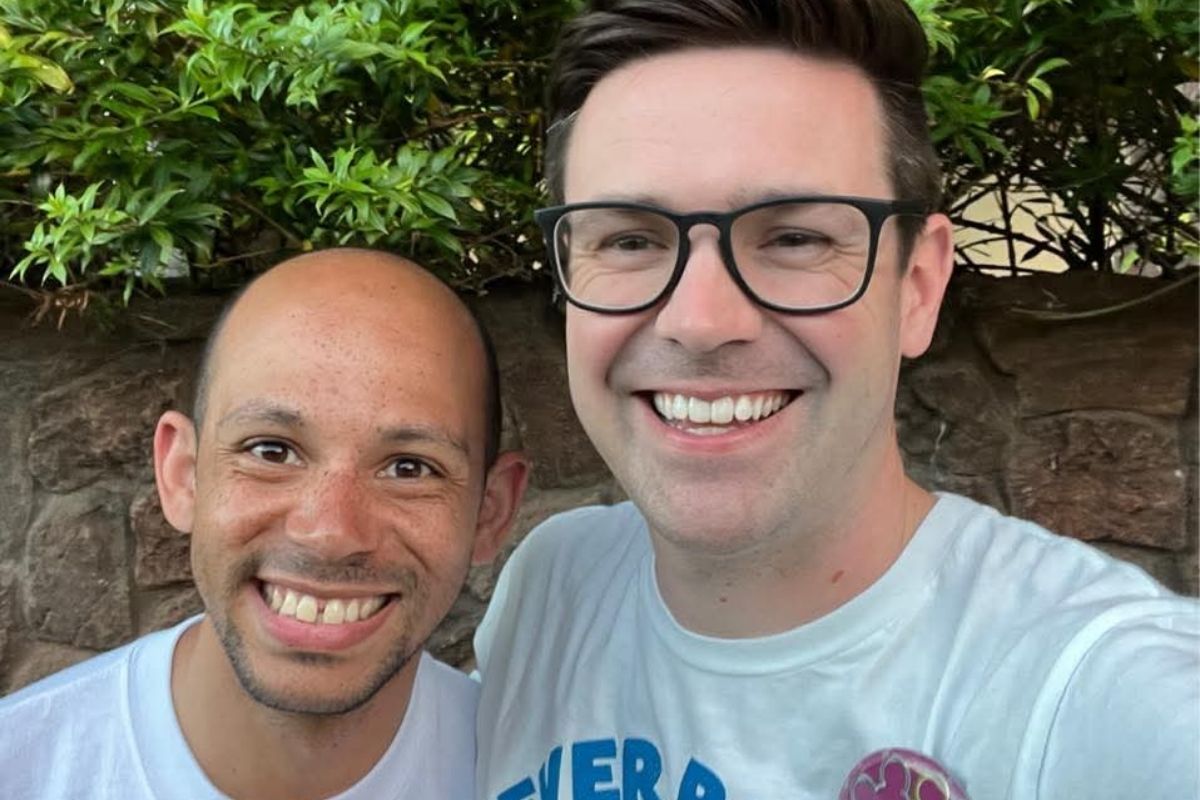
 “I love being able to show off Columbus State. The facilities are killer,” Nicholas
(pictured) said of the opportunity to continue hosting Thescon in Columbus while also
showcasing the city’s other strengths like the RiverCenter for the Performing Arts
and the Springer Opera Houses clustered around CSU’s theatre spaces. “You can walk
across the street from one to the other, and that’s unheard of in most other communities.
The fact that these spaces work so closely together and can spotlight that—it’s pretty
awesome.”
“I love being able to show off Columbus State. The facilities are killer,” Nicholas
(pictured) said of the opportunity to continue hosting Thescon in Columbus while also
showcasing the city’s other strengths like the RiverCenter for the Performing Arts
and the Springer Opera Houses clustered around CSU’s theatre spaces. “You can walk
across the street from one to the other, and that’s unheard of in most other communities.
The fact that these spaces work so closely together and can spotlight that—it’s pretty
awesome.”
Thescon is no small feat. Headquartered in the city’s Convention & Trade Center, the conference winds through Uptown Columbus and extends to most of the stages and facilities that comprise CSU’s RiverPark Campus—along with other venues like the RiverCenter for the Performing Arts and the Springer Opera House. Besides attendees, the three-day conference attracts vendors from around the country, requires hundreds of volunteers (mostly Columbus State theatre students), and generates a $3 million economic impact on Columbus annually through direct visitor spending.
“Thescon, for us, is like coming home. It’s one of those things that you can talk about all day long, but until you really experience it—to see what it looks like for 6,000 kids to take over a metro city area—it’s hard to imagine just how impressive it really is,” Richard explained.
Advocating for students and the performing arts
Richard’s and Nicholas’s roles in their organizations position them to advocate for the arts before educational and government leaders, both locally and nationally. Richard highlighted a recent alliance between the Educational Theatre Association and other advocacy groups, such as the National Endowment for the Arts and national associations representing art, dance and music.
“Our partnership helps ensure that, when we refer to ‘the arts,’ theatre arts is at the table and part of the conversation,” he explained. “That allows EdTA to have real conversations and a real impact on arts policies as they specifically relate to and benefit theatre.”
 His and Nicholas’ work at the national and state levels is also ensuring that schools
and school systems better leverage Title I for arts programs, especially those that
benefit and enrich socioeconomically challenged students. Involving students from
all backgrounds and skill levels, Nicholas explained, showcases theatre’s versatility,
even for students who will never step onto the stages of community theatre or Broadway.
His and Nicholas’ work at the national and state levels is also ensuring that schools
and school systems better leverage Title I for arts programs, especially those that
benefit and enrich socioeconomically challenged students. Involving students from
all backgrounds and skill levels, Nicholas explained, showcases theatre’s versatility,
even for students who will never step onto the stages of community theatre or Broadway.
“We talk about in acting classes the importance of diction and pronunciation—and those communication skills that many of us consider so basic but are essential to being confident in speaking to others,” he said.
“In my theatre tech classes,” Nicholas continued, “I’m teaching students how to sew buttons onto costumes, use power drills and paint sets—what was once the domain of vocational programs like carpentry and home economics. These are skills they’re going to use in life, even if they never go on to work in theatre.”
“In the theatre, there is no job that is too small,” Richard added, emphasizing how studying in theatre also develops teamwork skills. “It helps to understand and appreciate everyone’s contributions—from acting and costumes to painting, building and hanging lights.”
Both balance their association roles with teaching and professional theatre responsibilities. Richard is the executive and artistic director of Theatre Macon, founded in the mid-80s, which is one of the state’s leading community-based performing arts programs. He also teaches and choreographs for Warner Robins High School and the New York-based iTheatrics, which connects youth with musical theatre by adapting Broadway titles into age-appropriate “junior” versions. This work and similar projects throughout his career have included teaching and directing in six states and China.
“Our goal—whether in the classroom, the community theatre or in our advocacy roles—isn’t necessarily to create the next generation of theatre performers and practitioners,” Richard added. “We have the opportunity to create well-rounded human beings of all ages and at all stages of life who have the tools to be successful adults, lifelong learners and passionate arts advocates.”
For more than a decade, Nicholas has served as the director of theatre and a theatre educator at Warner Robins High School, where he was a student. His teaching duties include overseeing four productions each year, involving more than 300 students in acting, technical and design roles. He also collaborates with Theatre Macon as the director of its Academy, a program that helps young people aged 8 to 13 explore their passion and curiosity for theater arts.
As their careers have cycled through theatre roles, teaching positions and association leadership, they continue to find ways to support students as they graduate, seek jobs, and work as young professionals.
“As teachers, we’ve encouraged our students who want to major in theatre to attend Columbus State. Once they graduate from CSU, Richard and I have helped many of them seek professional and teaching jobs,” Nicholas explained. “So, it’s a cycle in our lives that CSU remains a part of.”
“We know the education they’re receiving at Columbus State, so as soon as they [graduate], folks know what to expect of them,” Richard added.
Media contact: Michael Tullier, APR