Columbus State University News
Experiential learning, Columbus PD partnership place students on the scene of crime investigation scenarios
March 5, 2026
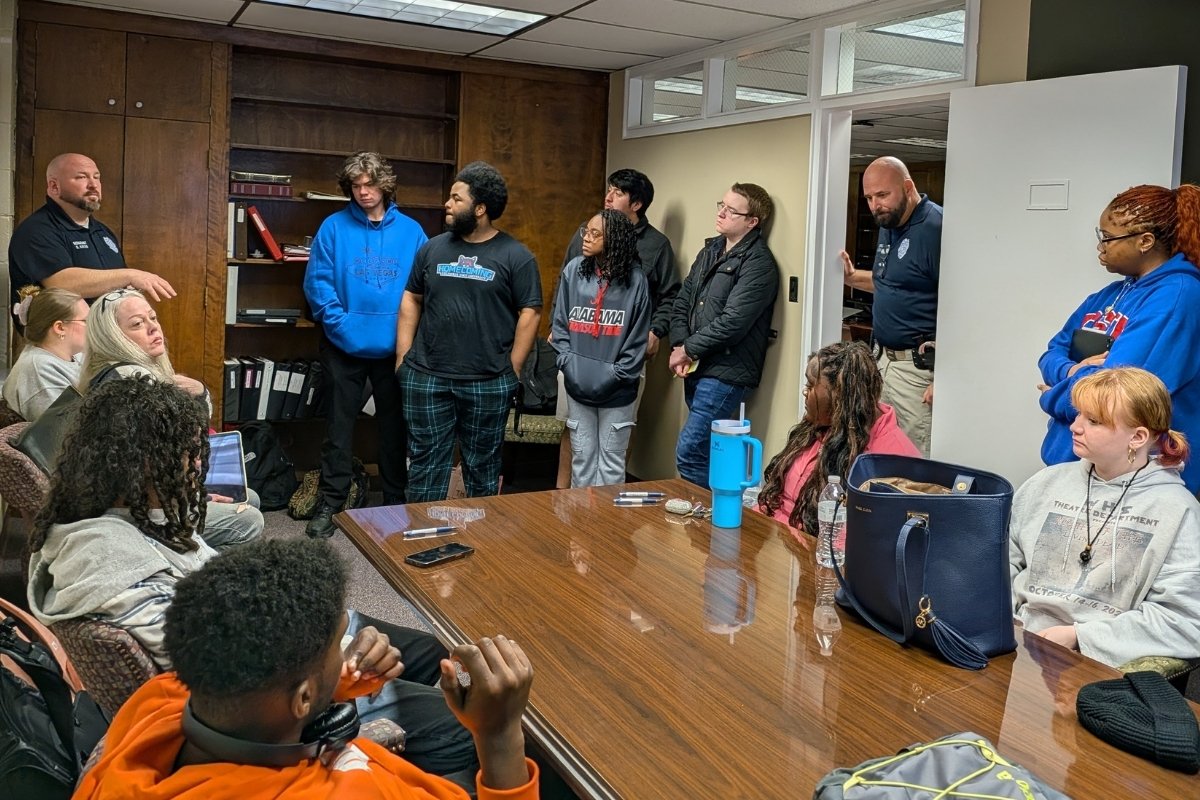
Imagine stepping into a world where textbooks and lectures disappear, replaced by the energy of a real crime scene. Undergraduate students in Columbus State University’s Criminal Justice program are engaging in immersive simulations that transform them from students into investigators, tackling the complexities of crime scene management under the watchful eye of seasoned law enforcement professionals.
In CRJU 3165: Criminal Investigative Techniques, immersive crime scene simulations mimic the challenges of real investigations. Exercises immerse students in dynamic, changing scenarios that require them to handle active crime scenes from first response through evidence collection and escalation.
“Recent research shows that higher education needs to help bridge the gap between theoretical knowledge and practical application, ensuring students develop critical thinking, ethical reasoning and decision-making skills needed for real-world scenarios,” explained Dr. Patrice Kerner, an assistant professor in the university’s School of Policy, Justice & Public Safety. “Building community partnerships to create these experiences helps not just the students, but the community as well.”
Kerner should know. She brings more than 25 years of public safety experience to her teaching role, along with extensive fieldwork and leadership roles across various state agencies, including the Georgia Public Safety Training Center and the Georgia Peace Officer Standards & Training Council.
For CRJU 3165, these simulations are part of an ongoing partnership with the Columbus Police Department and CSU’s University Police Department. Both agencies will continue to assist throughout the semester, offering students additional experiential learning opportunities that connect criminal justice instruction with professional practice.
Bridging theory and practice
By incorporating realistic crime-scene scenarios, Kerner said, the course bridges the gap between textbook theory and field practice, equipping students with the tactical precision and investigative mindset needed for high-stakes, in-demand careers in law enforcement, forensic analysis and public safety leadership. This hands-on approach ensures that students enter the workforce not only with a degree but also with the practical experience needed to navigate the complexities of investigative theory and modern criminal justice.
“Experiences like this get me excited about my major, because they put you in situations others on the job face daily,” explained sophomore Alexa Weiss, a criminal justice major from Senoia, Georgia. “It really got me into the mindset of what a crime scene investigator should do when it comes to a scene and some of the biggest points to remember—officer safety and evidence preservation.”
In the first of these exercises, students worked in teams of four, each assigned a specific professional role: scene security officer, witness officer, crime scene technician and lead investigator. Each role had distinct responsibilities, reflecting the structure of a real investigative team.
“Being able to step into the role of an investigator and actively work through a scene made me realize how passionate I am about this field,” said Columbus native and senior psychology major Ally Bennefield. “It helped me see how psychology and criminal justice connect, especially when analyzing behavior and decision-making.”
The scenario unfolded in three phases, introducing new developments and forcing students to reassess priorities on the spot. Teams had 20 minutes to handle the scene and 15 minutes for a structured debrief, during which they identified strengths, procedural gaps and potential legal consequences of errors. Students were evaluated by members of the Columbus Police Department’s Criminal Investigation Division.
The exercise allowed two-time Columbus State graduate Sgt. Robert A. Nicholas II ’13, ’17 to share his expertise with the criminal justice students.
“This type of instruction helps students to understand the requirements, expectations and dedication it takes to work in the field of criminal justice,” said Nicholas, who has a bachelor’s in criminal justice and a master of public administration from Columbus State. “Podcasts and documentaries can't compare to hands-on experience.”
Gaining professional perspectives
Nicholas and his colleagues assessed students on their ability to respond appropriately, secure the scene, protect evidence and clearly explain their investigative reasoning under time pressure. The assessment focused on procedural accuracy, prioritization and role execution rather than performance style or confidence.
“It also allows us to learn from our mistakes, which tend to stick more when in a simulation and not from a textbook,” Weiss said.
 “The goal is not perfection,” Kerner (pictured) added. “It is disciplined decision-making.
In real investigations, cases are often lost not because someone lacked intelligence,
but because someone skipped a step.”
“The goal is not perfection,” Kerner (pictured) added. “It is disciplined decision-making.
In real investigations, cases are often lost not because someone lacked intelligence,
but because someone skipped a step.”
Bennefield said the experience highlighted for her the importance of discipline and other career-ready skills in the criminal justice and public safety fields.
“This experience will benefit my studies by strengthening my critical thinking skills, attention to detail, and ability to work under pressure,” she said, noting it solidified for her an interest in a criminal justice career. “It also reinforced the value of teamwork and practical application, which will help me both academically and in my future career.”
Hands-on learning through simulations like these provides students like Justin Richman, a senior from Chicago majoring in interdisciplinary studies, with practical perspectives that connect classroom topics with real-world applications.
“Through my coursework, I get to break down complex issues from all angles—legal, historical, sociological and organizational—and I see how each perspective really matters in military leadership and aviation,” said Richman, who is also a member of the university’s ROTC program. “When I watch theory come to life in high-pressure settings like ROTC and Army training, the link between what I’m learning in class and my future career provides the feeling of realism and can one day potentially have an impact. It’s self-rewarding and demands discipline.”
He’s expecting to apply those perspectives, along with the critical thinking and attention to detail he’s honed in classes like Kerner’s, as he begins flight school at U.S. Army Fort Rucker after graduating this semester.
“Aviation demands discipline, precision and split-second decisions, which align perfectly with the leadership and analytical framework gained from Dr. Kerner’s class,” he explained. “It's a two-way street: my experience has given me real-world examples I can bring to class, making my academic work more practical and rooted in what I’ve actually faced.”
The U.S. Bureau of Labor Statistics forecasts that demand for public safety professionals in Georgia will grow over the next five to seven years. This includes a 12% to 14% increase in the number of forensic science technicians through 2033 and a projected 7% rise in law enforcement officers—driven by rapid population growth in metro areas like Atlanta and increased investments in forensic technology at the state level. Likely employers include local police and public safety agencies, private-sector labs and firms, and state and federal agencies such as the Georgia Bureau of Investigation and the FBI.
Nicholas considers the Columbus Police Department’s role in this kind of experiential learning crucial for training future public safety professionals.
“The students clearly have a yearning to learn and actively pursue the opportunity for a ‘hands-on’ approach to instruction,” he noted. “It not only creates a necessary relationship with Columbus State University, but it provides officers an opportunity to share what they know and students with a way to create relationships within their field of study.”
This type of experiential learning is becoming more common at Columbus State. As outlined in its current five-year strategic plan, the university aims to improve students’ career readiness and employability, as well as CSU’s impact on local workforce development, by engaging 100% of its students in an experiential learning opportunity within their field of study by 2030. This is achieved through a mix of classroom-based experiences, such as Kerner’s course, as well as micro-internships, internships, co-ops, and other hands-on activities coordinated in part by the university’s Center for Career Coaching.
News image: Columbus Police Department officers brief Columbus State University criminal justice students on the details of the crime scene scenario as part the course CRJU 3165: Criminal Investigative Techniques.
Media contact: Michael Tullier, APR, Executive Director of Strategic Communication + Marketing, 706.507.8729, mtullier@columbusstate.edu