Columbus State University News
Research: Ancient fossil upends assumptions about origins of two-thirds of all freshwater fish
October 2, 2025
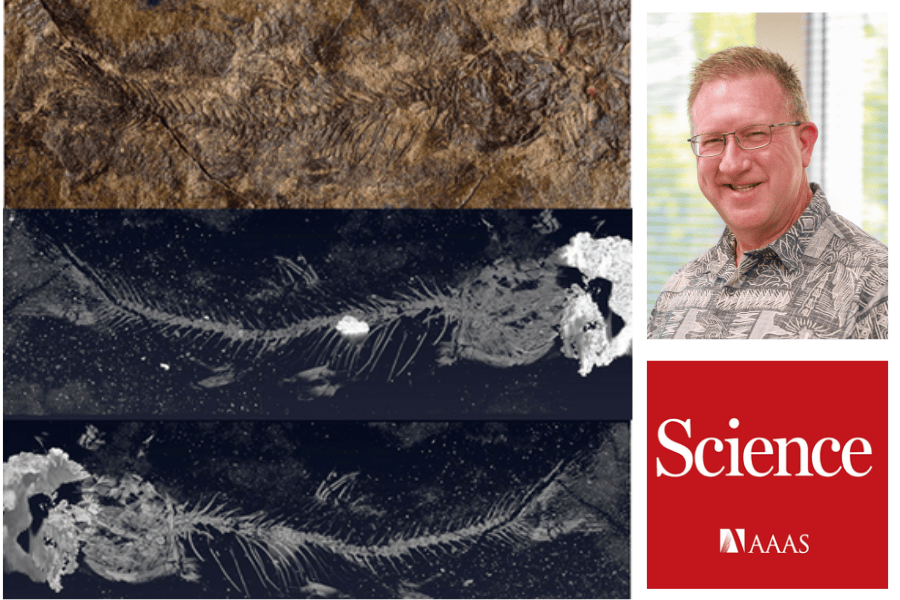
A study of a recently discovered ancient fish fossil is changing the long-held belief that the world’s most common freshwater fishes originated in rivers and lakes. The study, published in the scientific journal Science, reveals that these fish—a group that includes familiar species like minnows, catfish and piranhas—actually trace their evolutionary roots to the ocean.
A team of paleontologists and biologists—including Dr. Mike Newbrey of Columbus State University’s Department of Biology—uncovered a 66-million-year-old fossil of a new species, Acronichthys maccagnoi, in Alberta, Canada, in 2012, which led to their recent conclusions. This small fish, about the size of an adult human's finger, is one of the earliest known members of a group called Otophysi, which today makes up two-thirds of all freshwater fish species on Earth.
The findings of this research—led by Dr. Juan Liu from the University of California,
Berkeley and Dr. Donald B. Brinkman from Canada’s Royal Tyrrell Museum of Palaeontology—are
important for understanding the history and global spread of freshwater fish. It highlights
how these fish were able to cross the difficult boundary between marine and freshwater
ecosystems. This transition is rare in the animal kingdom and provides a model for
understanding similar evolutionary events.
 Newbrey (standing, third from right) with other members of the Acronichthys maccagnoi
fossil excavation team.
Newbrey (standing, third from right) with other members of the Acronichthys maccagnoi
fossil excavation team.
The published study, “Marine Origins and Freshwater Radiations of the Otophysan Fishes,” combines fossil evidence with genomic data from modern fish to present a different
evolutionary interpretation. For more than a century, scientists thought that the
ancestors of Otophysi evolved in freshwater on ancient continents, now known as the
supercontinent Pangea before it broke apart. The problem with this idea is that there
was about a 100-million-year gap between when Pangea broke up and when Otophysi first
appeared in the fossil record. Otophysi appeared about 154 million years ago after
the breakup of Pangea. The research also suggests Otophysi originated in the ocean
and only later moved into freshwater habitats on at least two separate occasions after
the continents began to move apart.
Developing the sense to “hear”
The fossil also provides new insights into how these fish evolved their unique ability to hear. This group of fish is often referred to as “hearing specialists” because they possess a highly developed sense of hearing due to specialized anatomical structures that detect and process sound waves underwater.
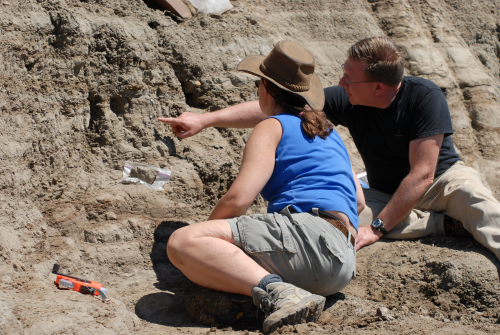 All fish can hear to some extent, Newbrey (pictured on location at the Alberta, Canada,
excavation site) explained, but generally their hearing is poor. Over millennia, hearing
specialists have adapted to listening to each other’s signals. The Chattahoochee River
and other regional waterways are home to many of these species—bullheads, channel,
blue and flathead catfish, minnows, carps and suckers—that can communicate with each
other.
All fish can hear to some extent, Newbrey (pictured on location at the Alberta, Canada,
excavation site) explained, but generally their hearing is poor. Over millennia, hearing
specialists have adapted to listening to each other’s signals. The Chattahoochee River
and other regional waterways are home to many of these species—bullheads, channel,
blue and flathead catfish, minnows, carps and suckers—that can communicate with each
other.
Aquarium fish like the popular loaches are also hearing specialists and make snapping noises to communicate with each other. These sounds can help them identify species, attract mates, deter predators, establish dominance or indicate social status, indicate injury or distress, and maintain territory during disputes through croaks (“barking” when captured), grunts, clicks, snaps, pops and stridulations.
The fossil has a unique hearing apparatus, a complex system of bones called the Weberian apparatus, which connects the swim bladder to the inner ear to amplify sounds. The study found that the development of this enhanced hearing ability may have evolved as the fish transitioned from saltwater to freshwater environments. Rivers are noisy, and freshwater does not transmit sound as easily as saltwater. Consequently, hearing specialists adapted to and were influenced by their environments to be better listeners than their marine ancestors.
 Newbrey (pictured) said this research can be applied to and could potentially revise
our understanding of the complicated evolutionary histories of other groups of fish.
For example, there is a long debate about how strictly freshwater cichlids that evolved
in Africa during the last 65 million years colonized South America. South America
and Africa separated from each other about 105 million years ago.
Newbrey (pictured) said this research can be applied to and could potentially revise
our understanding of the complicated evolutionary histories of other groups of fish.
For example, there is a long debate about how strictly freshwater cichlids that evolved
in Africa during the last 65 million years colonized South America. South America
and Africa separated from each other about 105 million years ago.
Science is a leading outlet for scientific news, commentary and cutting-edge research, published by the American Association for the Advancement of Science (AAAS), the world’s oldest and largest general science organization. Through its print and online incarnations, it reaches an estimated worldwide readership of more than one million. Its authorship is global too, and its articles consistently rank among the world's most cited research.
In addition to Newbrey, Liu and Brinkman, the research team and manuscript co-authors include Alison M. Murray of the University of Alberta (Canada), Zehua Zhou of Michigan State University, Lisa L. Van Loon of Western University (Ontario, Canada), and Neil R. Banerjee of Western University (Ontario, Canada).
Main image: an image of the Acronichthys maccagnoi fossil (courtesy of Dr. Juan Liu of the University of California); Newbrey; the Science journal logo.
Media contact: Michael Tullier, APR, Executive Director of Strategic Communication + Marketing, 706.507.8729, mtullier@columbusstate.edu