Columbus State University News
Robotics engineering students design, build scalable automated solution for Pratt & Whitney part-sorting needs
June 24, 2026
Senior Robotics Engineering undergraduates at Columbus State University collaborated with a leading global aerospace company, spending their last academic year developing an automation solution that bridges classroom knowledge and factory application.
The 2025-26 Senior Design Capstone course marked a first-ever partnership between the Robotics Engineering program and the Pratt & Whitney Columbus Engine Center. The students’ challenge? Design and develop an advanced automated sorting prototype for engine caps and plugs set aside or left unused during manufacturing and maintenance, to facilitate their reuse.
“Our capstone project covers all key technical areas of our Robotics Engineering curriculum, including embedded systems, AI-enabled computer vision, machine intelligence, control systems, sensors and actuators, and signal processing,” Dr. Mohammad Jafari, Senior Member, IEEE, an associate professor of robotics engineering, explained. “In practical terms, it offered students valuable hands-on experience in project planning, budgeting and time management, while also providing opportunities to work with practicing professionals in the field.”
The project, spanning two academic semesters, simulated real-world industrial competition and collaboration, “giving students a taste of what the real world will be like professionally,” said Ryan Ainsworth of Pratt & Whitney’s Technology Group, which guided the students throughout the capstone project. “[Projects like this] give them examples of real-world applications and expectations for getting the work done on time and done right.”
Getting the work done on time and right—and as part of a team—was important to senior Parker Metcalf of Valdosta, Georgia.
“You feel like if you don’t do your part, you’re holding everyone else up,” he explained. “You’ve got to come through. You don’t want to be the one to hold everyone else back.”
The high-stakes nature of a practical project with a real-world client like Pratt & Whitney carried more weight than hypothetical class assignments and projects, according to senior Jason Nickerson of Columbus.
“This is certainly more applicable and transitory to what we might actually do in our careers,” Metcalf explained. “We got to see how teams work, and how the repercussions of decisions affect individual and group productivity and workflow.”
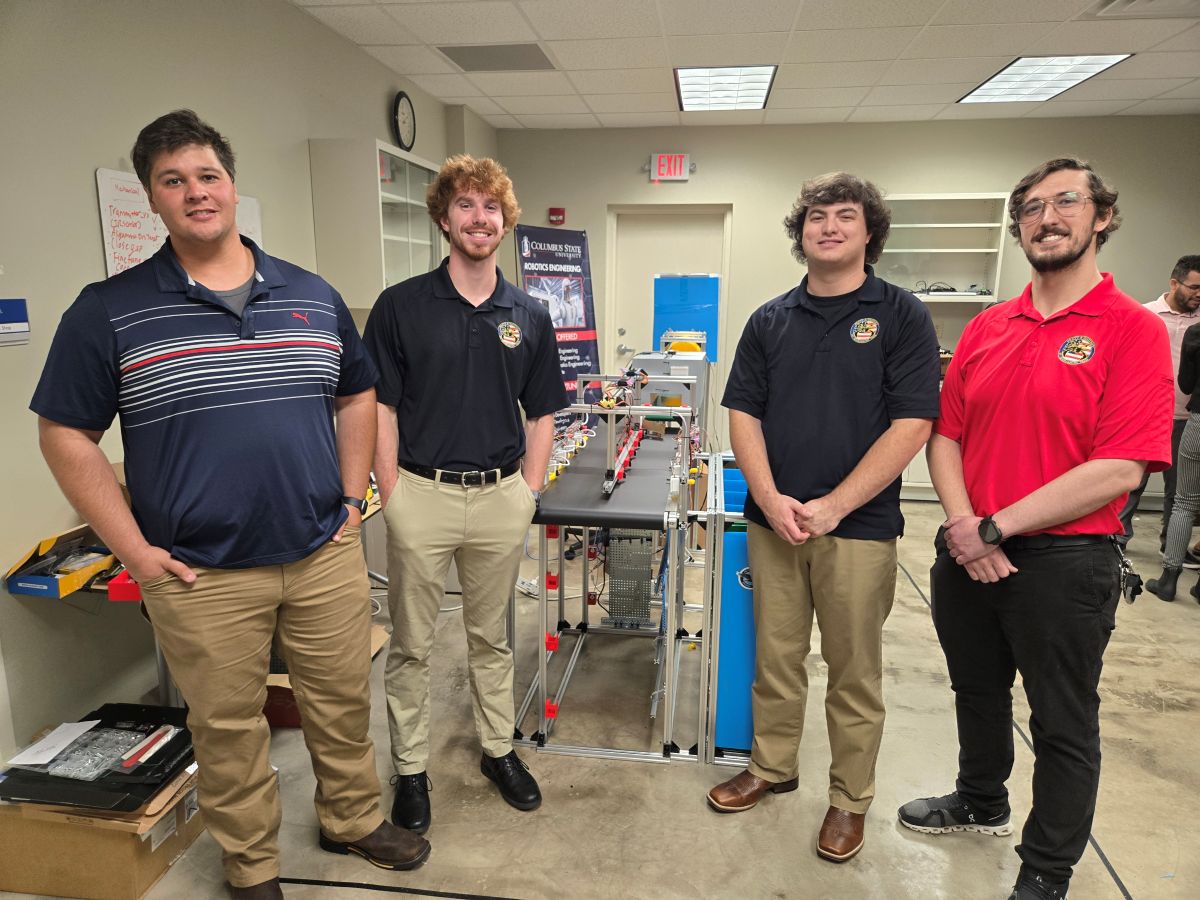 Metcalf (far right) was one of three team seniors who led project teams under Jason
Nickerson's (far left) leadership as the project's CEO. Other team leaders included
Owen Hartshorn (second from left) and Earnest Davis (third from left).
Metcalf (far right) was one of three team seniors who led project teams under Jason
Nickerson's (far left) leadership as the project's CEO. Other team leaders included
Owen Hartshorn (second from left) and Earnest Davis (third from left).
Pratt & Whitney engineers and managers— including alumni like Roxann Poole ’25—provided students with weekly technical guidance. The company also allocated funds
to supply all necessary materials. By regularly receiving technical and budget updates
from the team, students gained firsthand experience of the real-world accountability
faced by engineers, software developers and project managers.
A two-phase, team-based approach
Pratt & Whitney currently relies on a completely manual process for cap-and-plug sorting, managed by a single employee who dedicates their 40-hour workweek to manually separating over 2,800 caps and plugs daily. The students’ custom sorting prototype integrates AI-powered computer vision, machine intelligence-based classification, and robotic actuation to recognize and sort parts more efficiently.
As components move along the conveyor, cameras overhead take images and analyze them instantly with AI-powered computer vision to identify the cap or plug by its visual features. After classification, the system decides where to send each item and activates the suitable sorting device, with flippers positioned on the conveyor to direct the caps and plugs into their respective collection hoppers.
Throughout the project, students handled designing, integrating, and validating various subsystems, all while balancing accuracy, reliability, throughput and cost constraints.
“The project required students to integrate multiple robotics technologies into a unified system,” Jafari explained. “The sorter combined AI-powered computer vision and machine-intelligence algorithms for part classification, embedded controllers for real-time decision making, sensor systems for object tracking, and electromechanical actuators for physical sorting.”
To address Pratt & Whitney’s challenge, the class of 10 students split into three teams of three or four members in the fall semester. Each team developed a distinct prototype system through conceptualization, design and construction. These varied designs demonstrated different technical approaches to the sorting problem, allowing Pratt & Whitney representatives to evaluate a diverse array of customized robotics, automation and software solutions.
As the spring semester began, pressure increased. Pratt & Whitney chose one of the three prototypes for final development. Following the competitive phase, all 10 students collaborated as a single team to bring the chosen system up to industry standards, with Nickerson acting as its CEO.
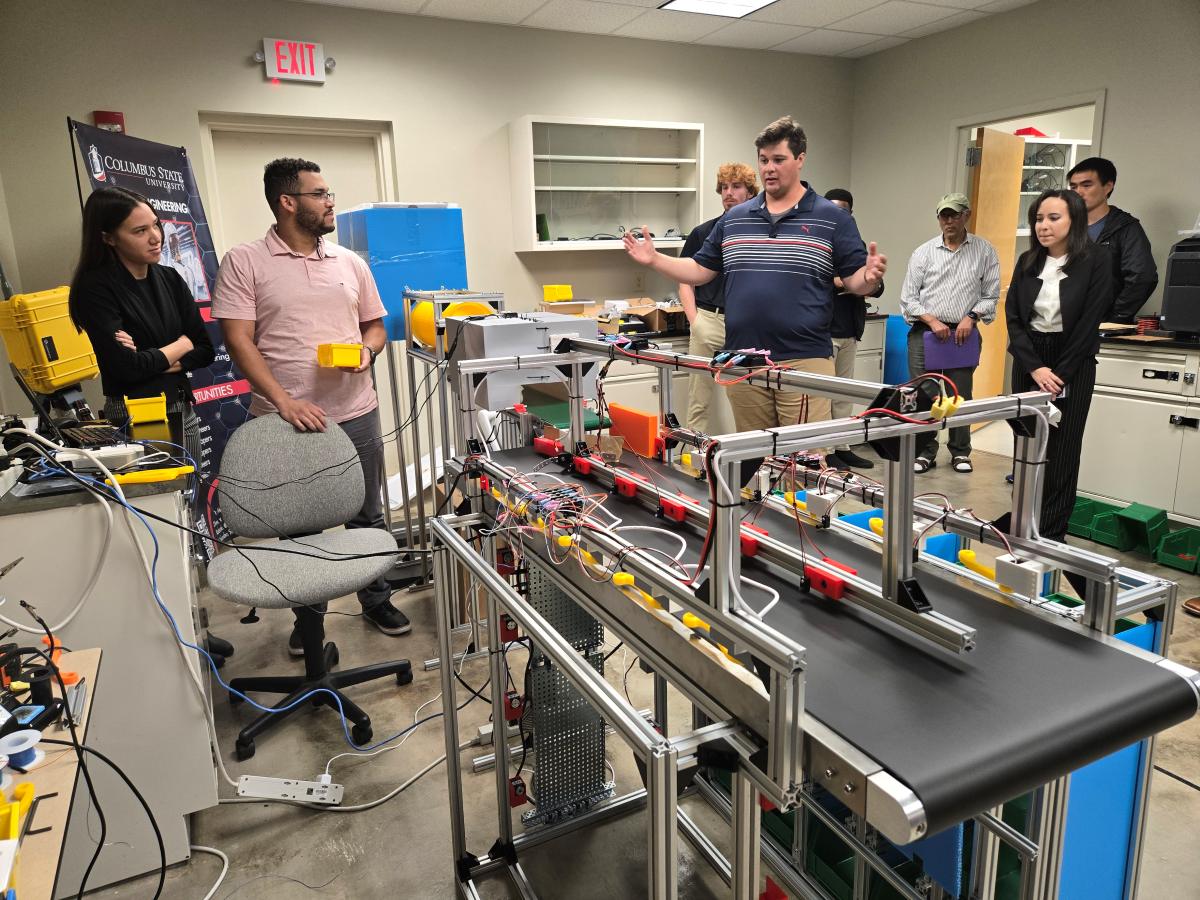
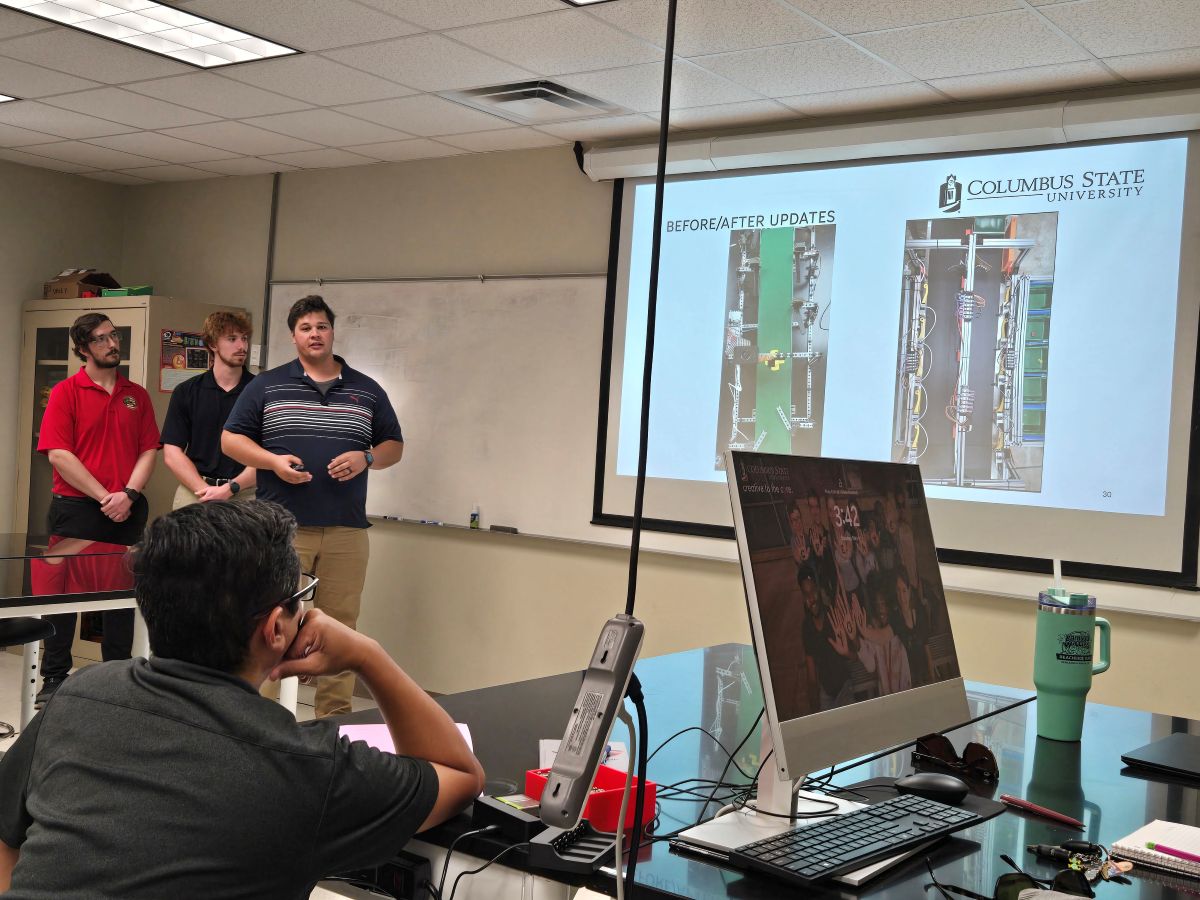 Nickerson and other team leaders present their process for designing and building
their prototype for Pratt & Whitney.
Nickerson and other team leaders present their process for designing and building
their prototype for Pratt & Whitney.
Nickerson noted that while the project required extensive robotics engineering skills,
it also provided students with a valuable testing environment for developing key career-ready
abilities. Following a framework akin to that of professional engineering firms, students
gained experience in project management, teamwork and technical communication.
“What impressed me most was how effectively the students embraced the professional expectations of the project,” Jafari explained. “They regularly met with engineers at Pratt & Whitney, responded to technical feedback, adapted to changing requirements and worked through real-world challenges such as supply-chain delays and budget limitations. By the end of the project, they were functioning much more like a professional engineering team than a group of students.
The project demanded real-time problem-solving as students faced actual supply chain management challenges, according to Hartshorn, who led the visual capture team in the spring. Hartshorn, a senior from Columbus, noted that issues like costs, inventory shortages and shipping delays posed real-world obstacles, requiring students to adapt, revisit their plans or produce their own parts with 3D printers.
The sorter prototype now serves as a proof of concept for Pratt & Whitney to evaluate for large-scale deployment. According to Jafari, scaling up the system would involve increasing production from roughly three to six parts per minute to 120. This expansion would necessitate a bigger conveyor, additional collection bins and improved technology for part recognition.
Nickerson (center) previews the automated sorter prototype for classmates and Pratt
& Whitney representatives in the Robotics Engineering lab.
Jafari pointed out, however, that building a better mousetrap, so to speak, isn’t
as important as the students’ efforts to build the mousetrap in the first place.
“Regardless of whether Pratt & Whitney ultimately deploys the prototype, the most important outcome is what the students gained from the experience,” he said. “They worked through the complete engineering design cycle—from requirements gathering and concept development to prototyping, testing, budgeting and final delivery. They learned how to communicate with an industry customer, manage project constraints and make design decisions based on real operational needs rather than hypothetical classroom assumptions.”
Strengthening the talent pipeline
The partnership underscores Columbus State’s role in developing the future workforce for the state’s high-tech, high-demand industries. Located just 15 minutes from the university’s Main Campus, Pratt & Whitney’s Columbus Engine Center strengthens the link between university education, industry needs and regional workforce development. It also undergirds the university’s commitment to providing every student with a degree- or career-oriented experiential learning opportunity before graduation.
For graduating seniors, this capstone experience is more than just a final grade—it serves as a portfolio-defining project that demonstrates their readiness to lead in robotics, AI and automation. Besides the common challenges of needing more time and funding, the class actively offered suggestions, like adjusting the project timeline, to Pratt & Whitney representatives to enhance future capstone collaborations. Everyone agrees they hope the Robotics Engineering program and Pratt & Whitney will maintain this partnership.
“Having this opportunity [to partner with Pratt & Whitney] gives students opportunities to observe industry operations and work in a professional setting they otherwise wouldn’t have,” Nickerson said. “We want this to go forward for other students and future partnership opportunities for them. Hopefully, it will lead to more on-site opportunities where they can gain professional experience prior to graduation.”
Media contact: Michael Tullier, APR