Columbus State University News
Study abroad helps Servant Leadership students embrace leadership, develop community in the Amazon
June 13, 2025
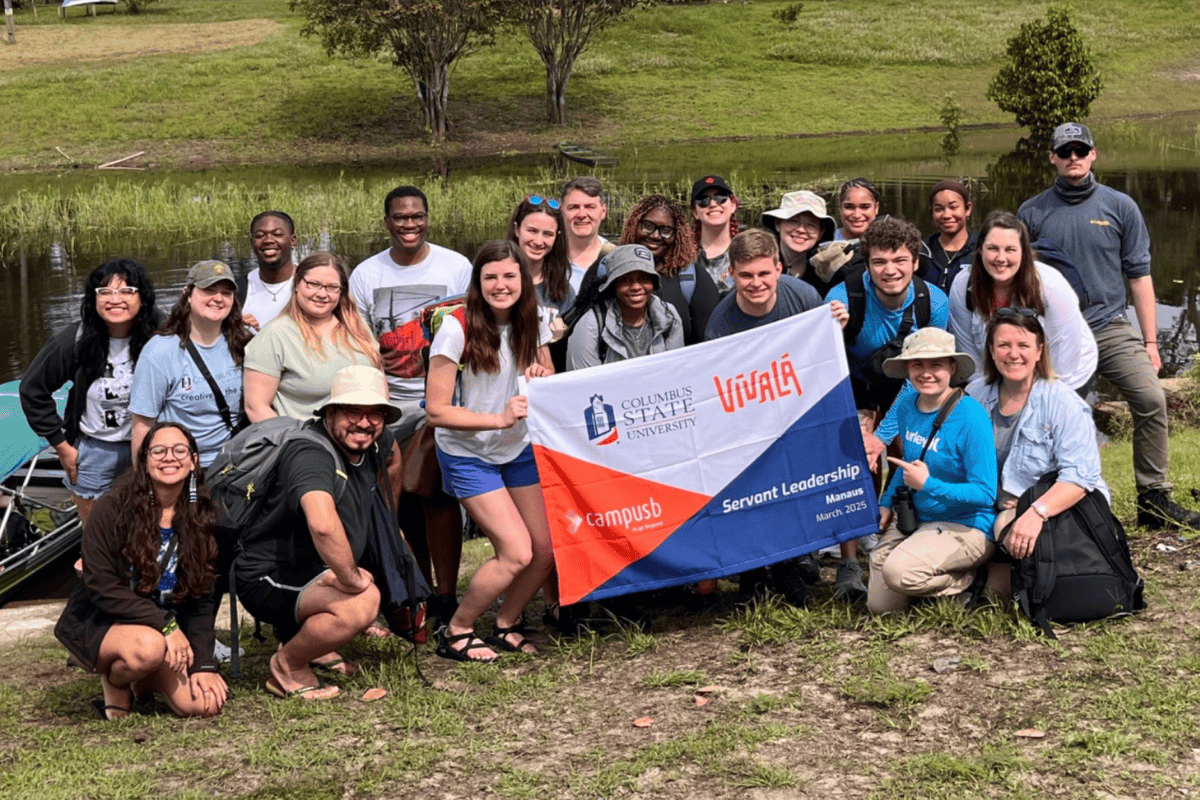
During spring break in March, a group of dedicated student leaders traded leisure for impact, traveling to Brazil as part of the Servant Leadership program’s biennial service-learning initiative. Joined by Honors College students and immersed in the heart of the Amazonas region, they worked alongside local villagers, tackling hands-on projects that addressed pressing social issues.
From cultural exchanges to leadership development, studying abroad provides students with a transformative experience—one that blends service, learning and personal growth in an unforgettable journey.
“This was an opportunity for students to both observe servant leadership and practice it in another culture,” said Servant Leadership Assistant Director Laura Pate. She and Director Cortney Wilson were pleased to offer this opportunity.
The Servant Leadership program embodied the same pioneering spirit it instills in its students, as program leaders and students traveled to Brazil for the first time as a group. Previously, they traveled to Costa Rica for service-based education. Here in Brazil, they grasped this new opportunity with the initiative that leaders know all too well.
Paige Abney, a junior from Cumming, Georgia, majoring in theater education, is one such leader—trading her nervousness for what could be a once-in-a-lifetime experience.
“[I thought], ‘When am I ever going to get an opportunity to travel with a group, and at such an inexpensive cost?’” Abney said of awaiting her first international travel opportunity.
Jarrett Huckaby, a Columbus-born senior majoring in Earth and space science with a secondary education focus, studied abroad last summer in Quebec with the Honors College. Still, he saw this trip as a unique opportunity, describing the chance to visit the Amazon jungle as “a dream of mine.”
Studying in Brazil was an awe-inspiring experience for Huckaby, who recalled that his expectations about the country transformed “as soon as I stepped off the plane. The pictures never do it justice.”
![Group of students posing around an "I [heart] Acajatuba" sign](/images/2025.06.spring.break.servant.leadership.acajatuba.png) The group spent one night in Manaus, the capital of the Amazonas state and the last
city before entering the tropical region. From Manaus, a large city though slightly
smaller than Atlanta, they traveled to Acajatuba, which is a small, geographically
isolated village in the Amazonas region where they would work and reside.
The group spent one night in Manaus, the capital of the Amazonas state and the last
city before entering the tropical region. From Manaus, a large city though slightly
smaller than Atlanta, they traveled to Acajatuba, which is a small, geographically
isolated village in the Amazonas region where they would work and reside.
The entire trip included an hour-and-a-half-long bus ride, followed by a 30-minute boat ride. In that sense, “the river was their highway,” Pate recalled. “It was one way in and out [to Acajatuba],” Huckaby affirmed.
CONTRASTING CULTURAL, LEADERSHIP PERSPECTIVES
The river’s importance came with its own share of problems. Rain could result in school getting cancelled, due to difficulty traveling along the river.
This highlighted the differences between the two. “Things paused for rain [in Acajatuba],” Pate recalled. “The community didn’t simply power through it and get wet.” The group maintained that Manaus had a more “hustle and bustle” nature when compared to the river village. “Those in Manaus do not necessarily stop for rain. They keep trucking along.”
The differences continued in the locale’s different takes on of personal vs shared effort. “In Manaus,” Abney deduced, “There was a sense of ‘trying to survive and make means for yourself.’” In Acajatuba, the emphasis was on communal wellness.
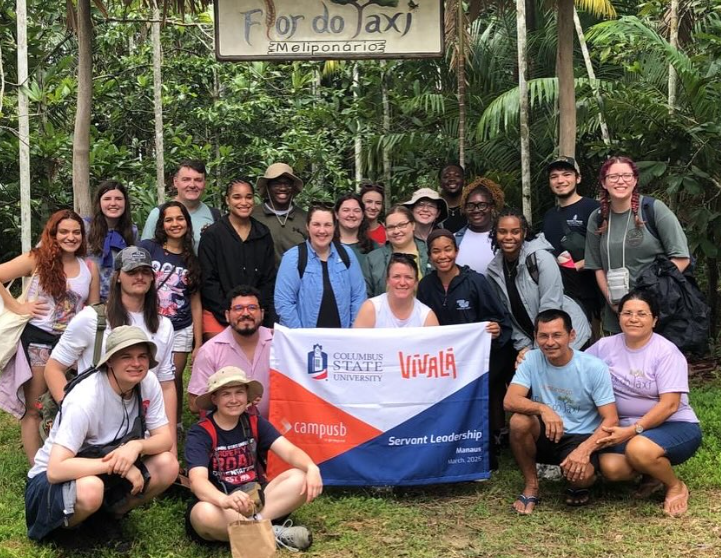 As students of leadership, Abney and her classmates’ meeting with the president of
the community gave them insights into both his leadership style and community. The
students observed the leaders’ attempts to network with other villages. They acknowledged
what Abney called “informal leaders of communities and families” coming together with
the goal of improvement. “It was really cool to hear how they explained leadership
styles and how it aligned without saying it.”
As students of leadership, Abney and her classmates’ meeting with the president of
the community gave them insights into both his leadership style and community. The
students observed the leaders’ attempts to network with other villages. They acknowledged
what Abney called “informal leaders of communities and families” coming together with
the goal of improvement. “It was really cool to hear how they explained leadership
styles and how it aligned without saying it.”
Pate said helping students come to those conclusions are part of the program’s goals of exposing them to different leadership styles and cultural perspectives.
“Giving students the opportunity to see servant leadership in places that may not use the term, students gain a better understanding of the applicability of their experience,” Pate said.
Pate also explained that the Service Leadership program exposes students to classroom- and field-based leadership principles. The more experience a student has, the better context they have for new experiences. Pate said, for example, students on this trip who traveled previously to Costa Rica were able to observe that the Brazilian village was at “a different stage of leadership and advancement” than the Costa Rican community. Those students also were able to compare how both villages were pursuing methods of sustainable tourism.
The group’s leadership studies extended beyond their village-based experience. Students visited local Coca-Cola corporate offices where students learned about the company’s sustainability efforts, as well as its plans to hire more women, provide more educational opportunities, and expand job resources for those with disabilities.
LEARNING IN THE GLOBAL CLASSROOM
Students benefitted from hands-on global learning that complemented studies in their major fields. They assisted locals in various ways—from wildlife and plant preservation to communal literacy and economic development efforts. Many participated in the Rio Negro Chelonians (River Turtles) project, which is a community-wide effort.
While many turtle species have been a source of food and commercial gain in the area,
increased hunting has unfavorably lowered the population. Project organizers pay individuals
to bring turtle eggs to the project’s location to mitigate the damage. By granting
an incentive to return the turtles to the project rather than selling them, the residents
are hoping to restore the population. The students helped by cleaning the turtles’
habitat, and by the end of the week, they released some of them back into the river.
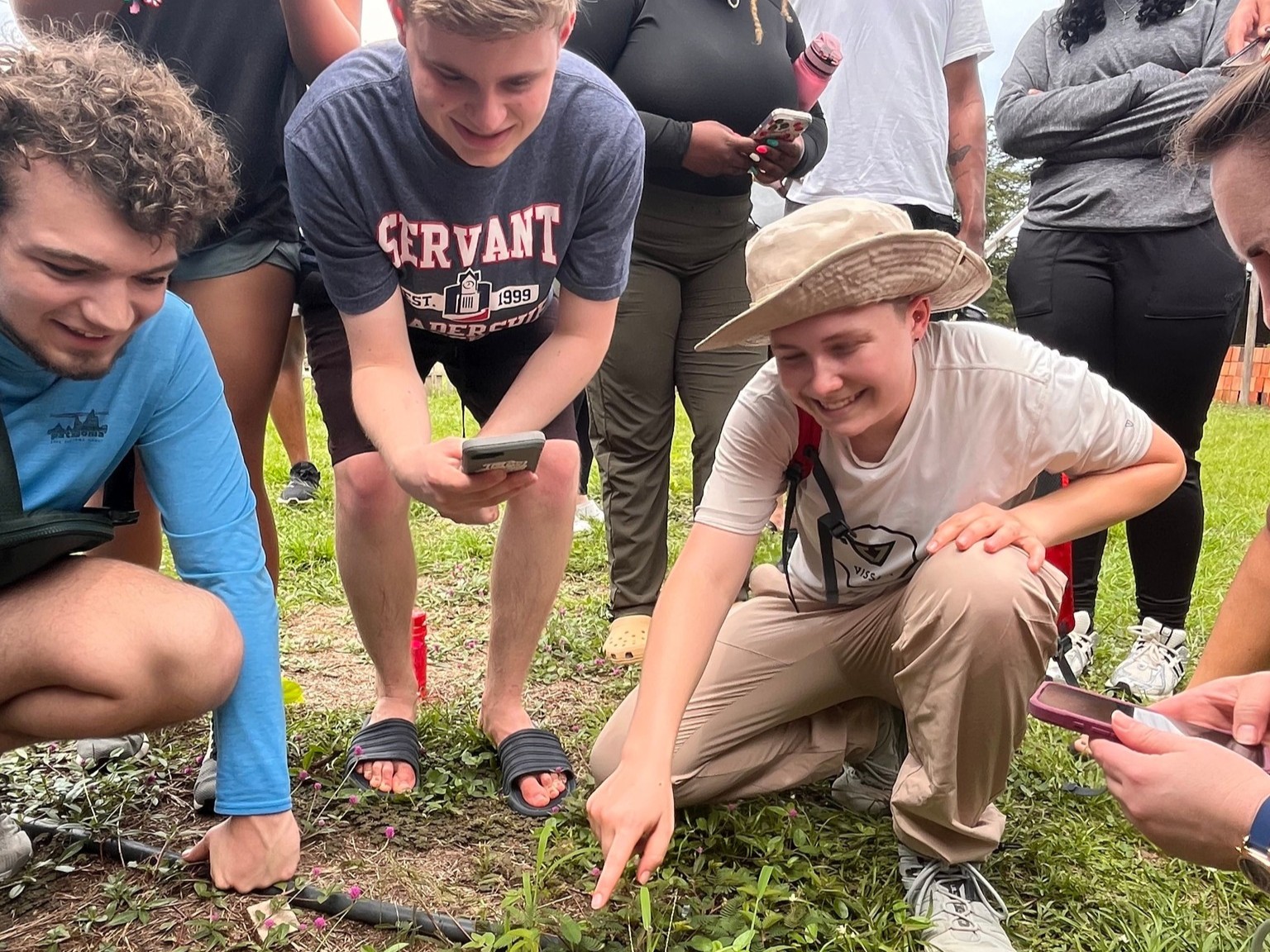
Huckaby’s (pictured above on far left with classmates) interaction with one guide enhanced his experience and immersion in the community.
“[Marigita] might have been the coolest lady I’ve ever met,” He recalled of his Brazilian guide who was born to German immigrants. Huckaby especially benefited from tales of traveling the world and her a career as a jewelry saleswoman at a large resort, and now her experiences as a jungle ecotourism guide and rescuing animals.
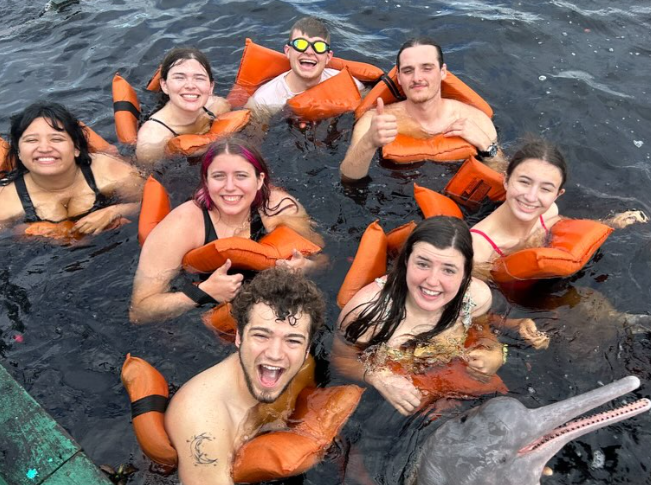 In addition to their work with turtles, Servant Leadership students got to swim with
pink dolphins (pictured), a species of dolphin found in South American freshwaters.
The village had a building where the dolphins could come for food, where the group
was able to feel and pet them.
In addition to their work with turtles, Servant Leadership students got to swim with
pink dolphins (pictured), a species of dolphin found in South American freshwaters.
The village had a building where the dolphins could come for food, where the group
was able to feel and pet them.
They also explored the Acajatuba jungle, where guides identified flora and fauna, noting what was safe to touch and what wasn’t. They also visited a bee farm and created homemade soaps using natural substances and local extracts with medicinal properties. Pate said they learned about the delicate balance of benefiting from nature while striving “not to exploit [it.]”
LEARNING TO COPE WITH THE UNFORESEEN
Study abroad opportunities come with challenges, which allow students to grow. In addition to coping with tropical weather much different than Columbus and the increased togetherness that comes with traveling with the same group of people, Huckaby “pushed through” a bout of food poisoning.
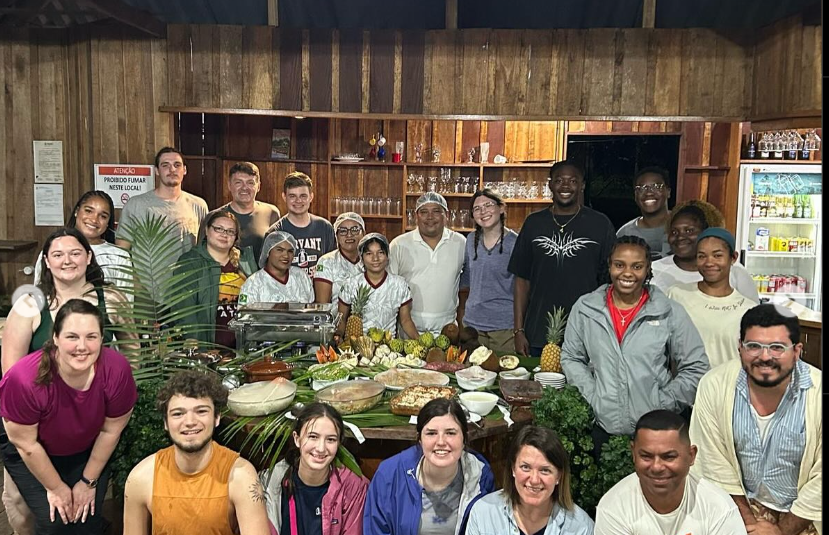 Abney recalled cultural differences between American and Amazonian timekeeping and
punctuality. After the group prepared for an 8 p.m. bingo game, they learned that
to the villagers “8 p.m. to us is really 9:30 p.m. to them—the game ultimately began
at 11.”
Abney recalled cultural differences between American and Amazonian timekeeping and
punctuality. After the group prepared for an 8 p.m. bingo game, they learned that
to the villagers “8 p.m. to us is really 9:30 p.m. to them—the game ultimately began
at 11.”
There seemed to be a cultural understanding that ‘things can always get done later.”
As much as the villagers valued leisure and rest, Abney added, the community was “incredibly hard-working,” toiling daily outdoors despite the heat and their constant perspiring. She drew from that her own observations of their self-imposed sustainability—noting that the community itself was a resource that could not be allowed to burn out. “They were sweating and still working,” Abney recalled, “but when they need a break, they take a break.”
Abney also recalled missing the creature comforts of home. She attempted to recreate a treasured scent during a soap making workshop.
While traveling with classmates is much different than traveling with family or lifelong friends, Huckaby embraced the group closeness with gusto.
“My most memorable moment was not a showstopper, but more of the feeling of camaraderie everyone on this trip gained together. I was able to make meaningful connections with [my classmates and the locals],” he recalled
Abney noted the camaraderie within the village where they lived, worked and explored.
“What shifted my perspective [during our trip] was the sense of community. Everyone was so connected and … [they were] working toward the same goal,” she said.
LIFE LESSONS FROM STUDY ABROAD
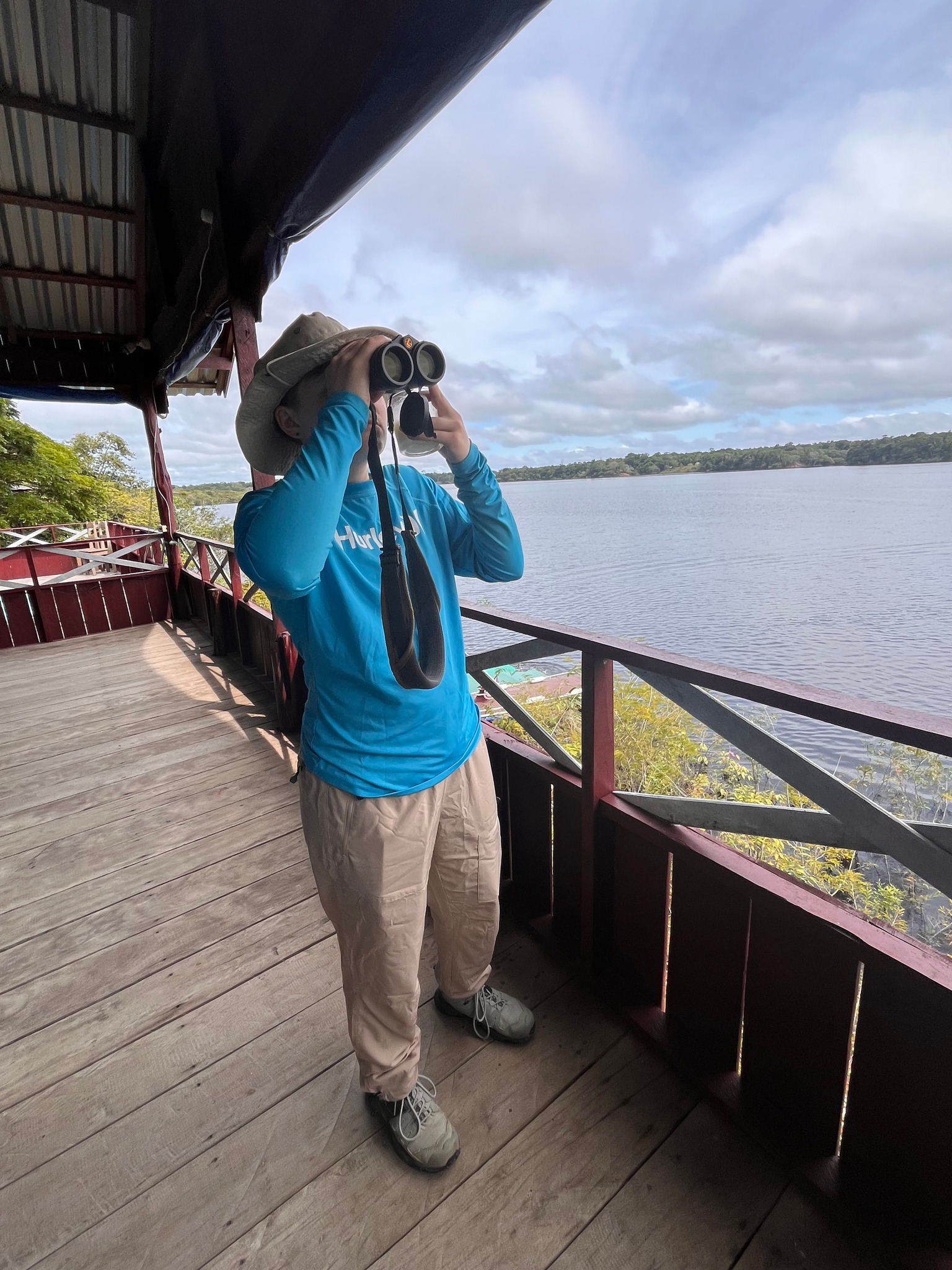 Abney, who aspires to teach drama after graduating with her theatre education degree,
took this sense of community to heart.
Abney, who aspires to teach drama after graduating with her theatre education degree,
took this sense of community to heart.
“It starts with one person teaching their children right versus wrong, from generation to generation,” she observed. “Change starts with one person, starting a cycle.”
Pate has guided study abroad experiences for students throughout her Columbus State tenure and has seen how students benefit from them during their studies and beyond college into their professional lives.
“These are the kinds of experiences that are really life-changing for students. It’s special for me to be part of students’ first trip abroad or first plane ride, and to see them walk away with a whole new perspective,” she said.
That’s a sentiment Abney hopes to emulate in her own teaching after she graduates from Columbus State.
“Teaching isn’t just lessons,” she explained. “It’s sharing experiences with younger generations, and them learning from that.”
Like Abney, Huckaby aspires to teach professionally and already sees how his South American experiences will aid him as a science teacher.
“I wanted this trip to be an experience that I could learn from and in turn use in my classroom to teach students,” he explained of his first-hand experiences, which will allow him to “show them how what they learn in their science class in Georgia can be applied somewhere remarkable like the Amazon rainforest. “This trip helped me remember there is always a bigger picture. It can be easy to become focused on our little sphere of life, but there is so much around us.”
He advises fellow students to pursue their own opportunities in true teacher fashion: “This can be a once-in-a-lifetime trip. Do everything you can immerse yourself. Try the piranha tongue. Dance in the streets of Manaus! You never know if these experiences will appear again.
Cynthia Short, a Spring 2025 professional writing intern in the Office of Strategic Communication + Marketing, submitted this article for publication.
Media contact: Michael Tullier, APR, Executive Director of Strategic Communication + Marketing, 706.507.8729, mtullier@columbusstate.edu