Columbus State University News
Transformative Year 1 positions Columbus State, Dimon Magnet Academy’s lab school partnership for continued success
November 3, 2026

Columbus State University and Dimon Magnet Academy are celebrating the successful first year of their Professional Development Lab School (PDLS). Year 1 outcomes data show significant gains in student progress, academic success and community engagement among students at both Dimon and Columbus State.
Launched in July 2025, the PDLS initiative brings together Columbus State University, the Muscogee County School District and Columbus Technical College to collaboratively address education, health and wellness through a unified community effort. The program was developed as a scalable, school-based model focusing on four strategic pillars:
- increasing K-5 student engagement and achievement.
- connecting Dimon families and Columbus State students through community engagement.
- expanding hands-on, experiential learning opportunities for CSU students.
- engaging school leaders and university faculty and students jointly in academic inquiry.
“The Professional Development Lab School was created on the belief that when schools, higher education, workforce partners, healthcare providers, families and the community work together, children gain greater access to the relationships, resources and opportunities they need to thrive,” explained Dr. Pam Wetherington, director of education and community initiatives in Columbus State’s College of Education & Health Professions.
During the 2025-26 academic year, the PDLS expanded learning opportunities for Dimon
Magnet Academy’s approximately 370 K-5 students. At the same time, more than 100 Columbus
State students—representing degree programs across the university—contributed to the
PDLS’ efforts while gaining hands-on experience applying what they’ve learned in their
majors and honing their servant leadership skills as tutors and mentors. Wetherington
reported that 97% of those Columbus State students credited those experiences with
helping them feel better prepared for their future careers.
 Dr. Pam Wetherington leads a discussion during a tour of the PLDS partnership.
“The numbers do more than quantify our partnership. They reflect more than a year’s
worth of impact—they reflect what is possible when a community chooses to invest in
its children,” Wetherington said. “The PDLS was never intended to replace the outstanding
work already happening at Dimon, but to build upon it.”
Expanding opportunities for K-5 students
At Dimon, all students qualify for free or reduced-price meals, approximately 21% receive special education services, and fewer than half were achieving grade-level scores on the 2024–25 Georgia Milestones Assessment when the PDLS program started. Despite these challenges, Dimon Magnet Academy Principal Emily Wilson focuses on the school’s strengths.
“Dimon has a solid foundation and is Georgia’s only state-certified STEM school in Muscogee County,” she explained. “Our faculty and administrators—half of whom graduated from Columbus State—are dedicated to evidence-based practices that enhance student engagement and achievement. Additionally, we maintain a strong connection to our community.”
A three-time Columbus State graduate herself, Wilson now counts the Professional Development Lab School partnership as another strength, and Year 1 outcomes reinforce that mindset. Wilson pointed to improved reading and math performance across every grade level, reflecting positive academic growth during the partnership’s first year.
Empowering Dimon families
As a magnet school, Dimon attracts students countywide via an application process. However, Wetherington and Wilson emphasized that, in developing the PDLS, it was crucial to involve and inspire the broader community around Dimon Magnet Academy—not only students’ parents and guardians.
The school is located in a long-established residential community that has gradually changed demographically. It has become a diverse community that reflects the families Dimon serves, with households primarily identifying as Black, along with Hispanic, multi-racial, and white residents.
The pair explained that this presented opportunities to support and empower families alongside Dimon students. Pre-PDLS needs assessments led to year-round programs that expanded opportunities for family, health and wellness engagement. Approximately 50 family members participated in eight monthly Family Literacy Nights, and over 80% of those families reported using the provided literacy resources at home.
Columbus Technical College has also played an important role in supporting family engagement through the partnership by contributing to Family Literacy Nights and helping connect Dimon families with educational opportunities and resources. Through the partnership, Wetherington noted, seven mothers of Dimon students have participated in an early childhood education credentialing pathway offered by Columbus Technical College, gaining professional credentials and career opportunities in early childhood education.
“Saying ‘yes’ to this partnership was easy,” added Columbus Tech President Martha Ann Todd, herself a 1993 Columbus State master of education graduate. “It was absolutely the right thing to do for Dimon’s students, its families and the broader community—and seeing these parents successfully defining a career pathway through professional certification is a testament to that.”
Preparing future servant leaders
In Year 1 of the PDLS, over 100 Columbus State students engaged in practice-based learning— undergirding the university’s strategic goal of offering degree-relevant experiential learning opportunities to all students by 2030.
Students applied their learning from programs in education, counseling, business, nursing and health sciences and robotics engineering. They used their classroom knowledge in activities such as tutoring, mentoring, counseling, family engagement, enrichment and workforce development. They interacted with Dimon students both as individual volunteers and as part of university communities like CSU’s NCAA athletics teams and its Servant Leadership Program.
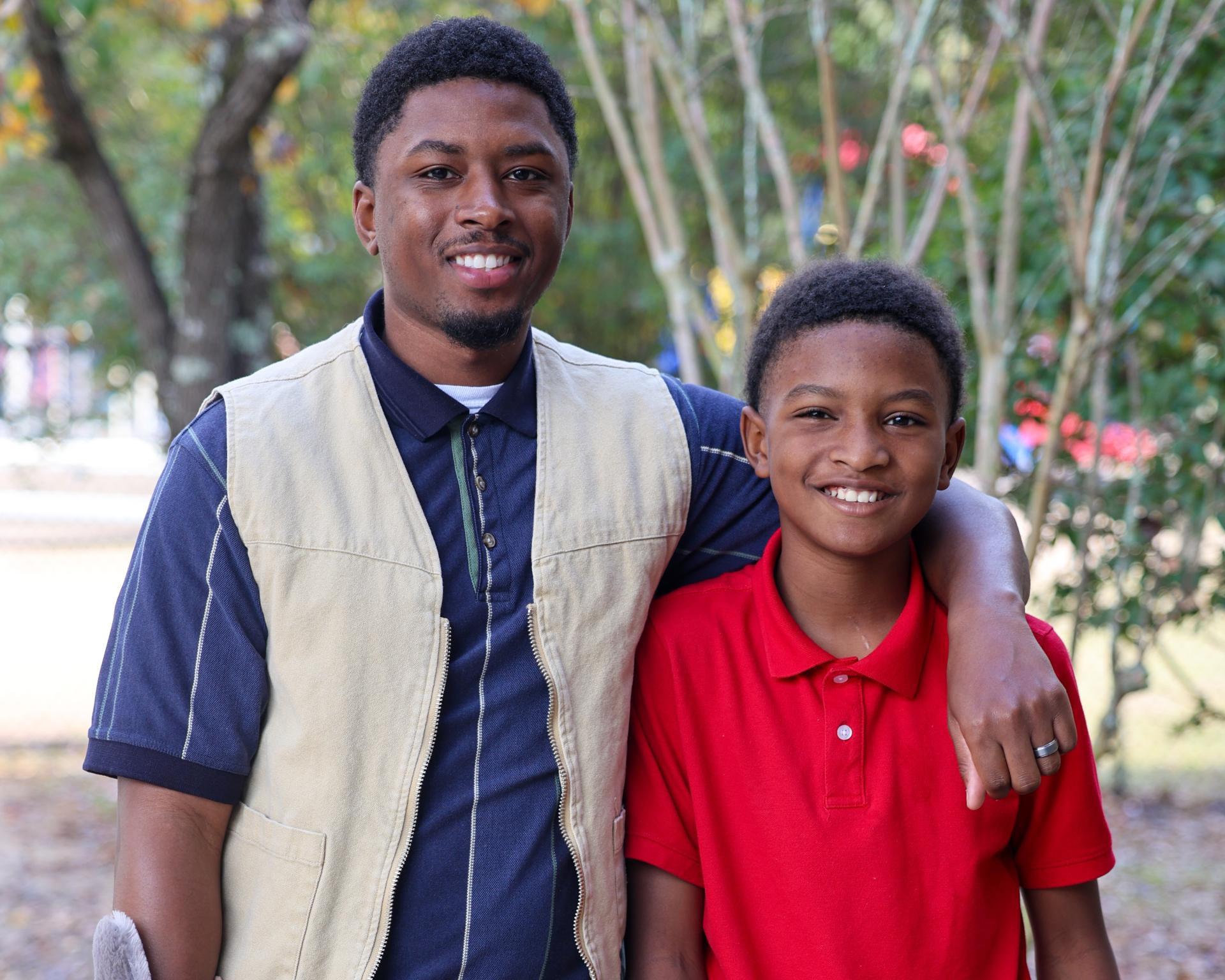 Engineering major Nehemiah Armstrong was among the 100-plus Columbus State students during Year 1 who gained hands-on
experience in their majors and practical servant leadership experience while serving
as in-school mentors to Dimon students.
While nearly all CSU student PDLS participants valued their participation, Dimon faculty and staff also acknowledged the partnership’s value. Over 85% believed CSU’s students, faculty and staff contributed positively to student learning, wellness and classroom support, while 87% felt communication and collaboration enhanced the partnership. Beyond the data, Wilson values the intangibles of having Columbus State students in her classrooms.
“Many of our students who need a strong role model and academic support now have a consistent, caring college student—often seen as rock stars—meeting with them each week and supporting both their academic and social-emotional development,” she explained.
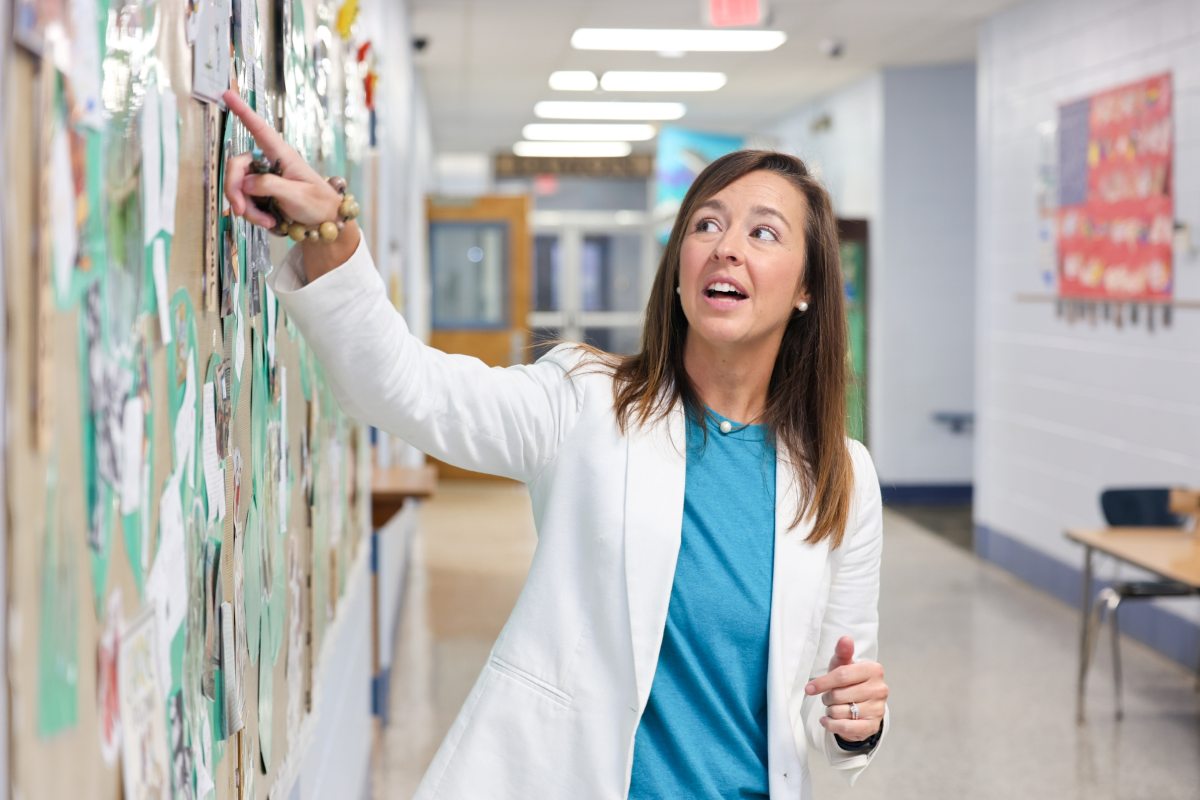 Dimon Magnet Academy Principal Emily Wilson
“An added bonus is that my students are talking about their futures through these weekly conversations, about college, careers, and what comes next,” Wilson continued. “When students start to see a clear path forward through education, careers and purpose, we are building pathways from the classroom and into the workforce. When they and their families begin to believe in what is possible for their future, everything changes—that is the true impact of this partnership.”
Looking ahead to Year 2
While Columbus State’s Teacher Education Program has long embraced aspects of lab school and professional development school models, university leaders such as Dr. Margie Yates, dean of the College of Education & Health Professions, envisioned expanding that foundation beyond just teacher preparation. Their goal was to involve students and faculty from various disciplines while collaborating with school districts, workforce sectors, healthcare and community partners.
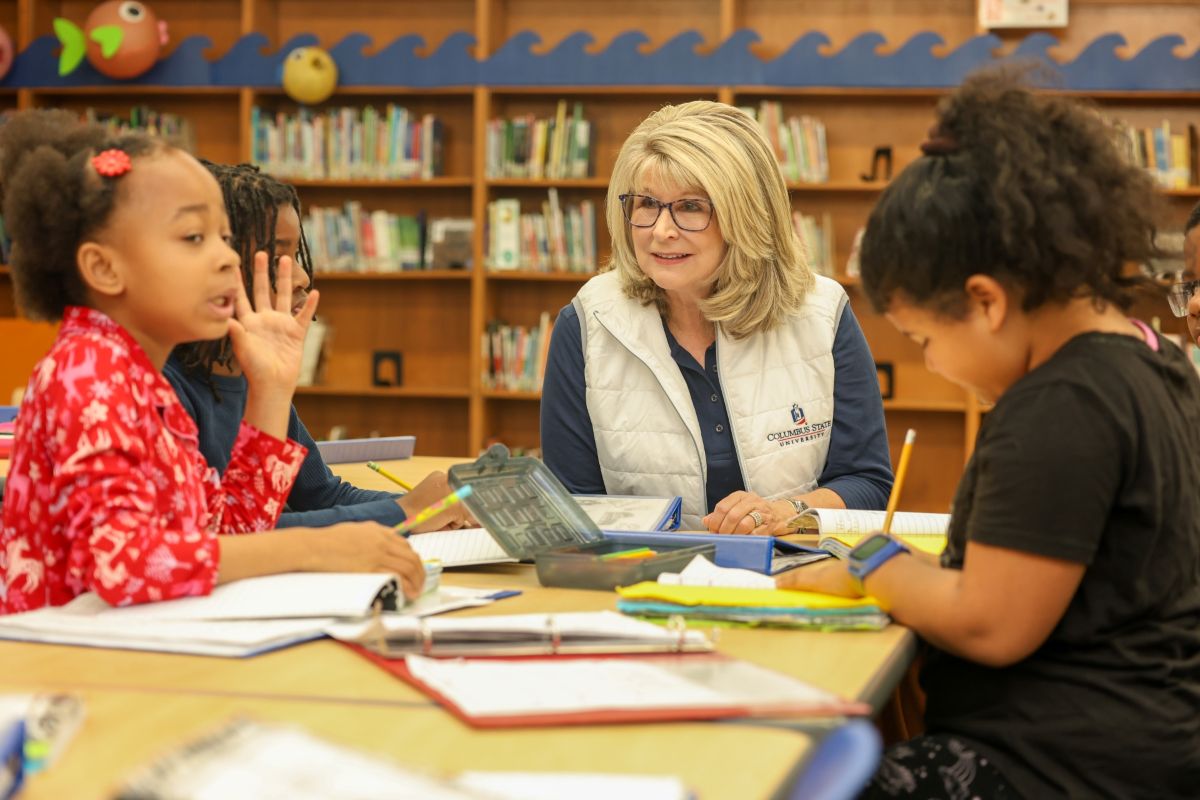 Dean Margie Yates sits in on a PDLS activity at Dimon Magnet Academy.
“We always envisioned something truly authentic—not something brick-and-mortar on our campus, but an opportunity to partner within a real school, in a real community, where the needs are clear and the impact matters,” Yates explained. “What we’ve built reflects that vision—an approach where education, health and wellness work together to support students and families.”
Columbus State and Dimon Magnet Academy recently kicked off Year 2 with a summer back-to-school bash. As the PDLS begins its second year, Wetherington noted plans to increase capacity for after-school tutoring and mentoring. She and Wilson also aim to introduce new family-centered engagement activities during the week and on weekends focused on STEM, the arts, and health and wellness.
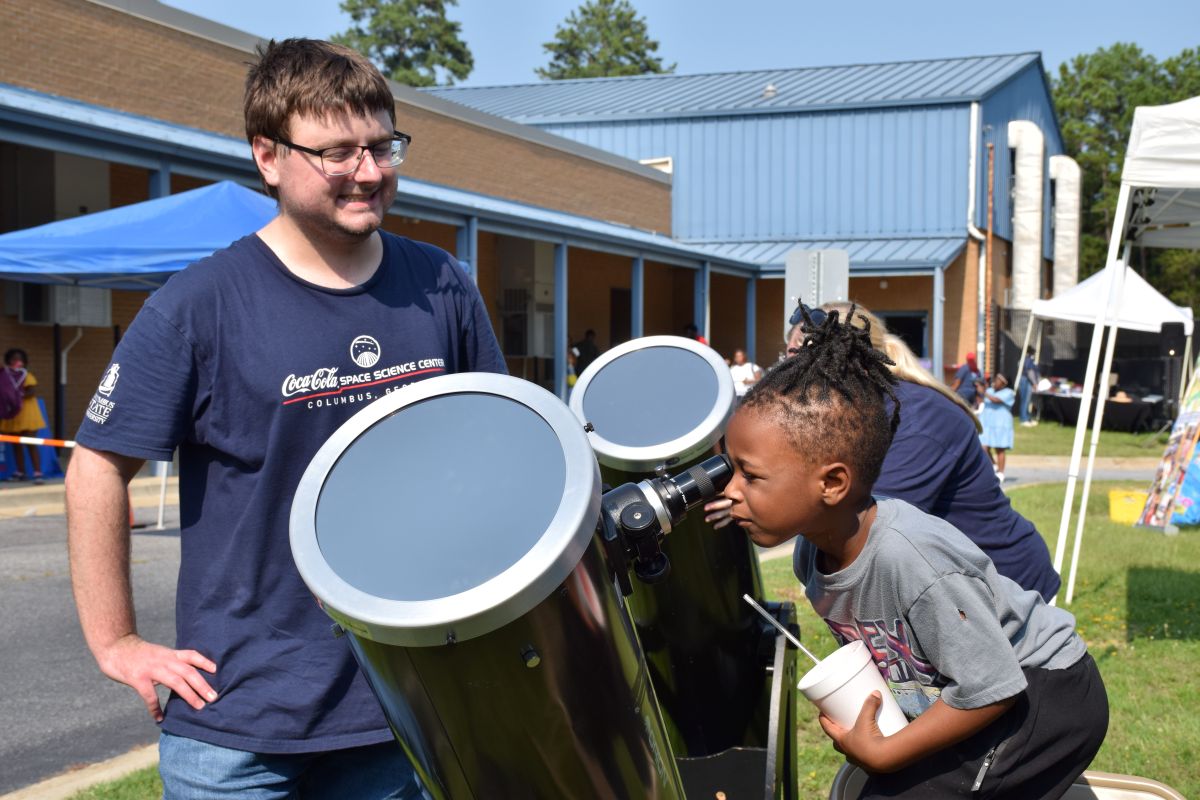 Students and faculty from Columbus State’s Coca-Cola Space Science Center were among
the experiences Dimon families benefited from during the PDLS Back-to-School Bash
in July 2026.
Columbus Technical College will continue supporting family engagement through Family Literacy Nights and Math Nights, including educational activities for children while parents participate in learning sessions. The partnership will also explore opportunities to expand adult education, credentialing and workforce pathways for Dimon families and the surrounding community.
Wetherington acknowledged two competitive grants obtained in Year 1 that increased the PDLS’s ability to deliver evidence-based literacy and family engagement programs and evaluate their results. These grants, along with upcoming ones and private donations, will continue strengthening the partnership.
More information about the PDLS partnership, including a downloadable version of its Year 1 Impact Report, is available on the university website.
Media contact: Michael Tullier, APR