Columbus State University News
Tunisian study abroad trip becomes passport to participating in the Model UN
May 3, 2023
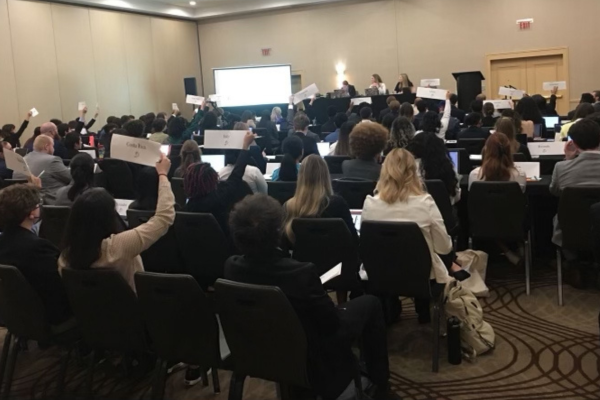
This past January, Columbus State University students Austin Murray, Spencer White and Lizzie Williams participated in a study abroad trip to Tunisia. The experience, part of “Intro to International Studies” (INTS 2105) taught by Dr. Alan Karass, was eye-opening and only increased their desire to expand their worldview. So, when they heard CSU was holding an interest meeting for its Model United Nations team, they decided to check it out.
The three—along with Michael Hurst, Liam Barry and Adrian Peterson—would eventually represent CSU during spring break in March 2023 at the Southern Regional Model United Nations (SRMUN). Hurst chose to represent Iraq while the remainder of the CSU contingent chose to represent Tunisia.
“Having been to the country I was representing, I felt more prepared to speak on its behalf,” White, a senior from Knoxville, Tennessee, double-majoring in music and interdisciplinary studies, said. “I’ve always had an interest in activities that helped me learn about other cultures.”
Model UN is an educational simulation of the real world United Nations, where students are given hypothetical problems that they must try to solve from the perspective of their chosen countries. Along with this, delegates from the same college or university are also split between different committees to broaden their interaction with other delegates. This year’s North Carolina-based conference included over 250 students from 36 universities, some as far away as Buffalo, New York.
Williams, a junior music education major from Canton, Georgia, affirmed how the Southern Regional Model United Nations program reinforced skills that will make her more marketable in her professional career.
“The SRMUN conference was a great look into a wide variety of aspects of the professional world—from dissecting real-world problems to developing collaborative skills that will aid me in every aspect of my professional life,” she noted.
Murray, a junior music performance major from Macon, Georgia, agreed that the emphasis on real-world problem-solving was something that appealed to him.
“Attending the SRMUN conference emphasized the importance of having discussions of real-world issues and how we can productively solve issues,” he noted. “Working together with students from around the country provided many different perspectives that all contributed towards creating solutions that help all people.”
“I loved getting the opportunity to collaborate between students across many different backgrounds and varying schools,” added Hurst, a native of Alabaster, Alabama, and a junior majoring in music performance. “I was able to immerse myself in an environment that promotes creative problem-solving situations, and that allowed everyone to express themselves and contribute in ways that I originally didn’t know were possible.”
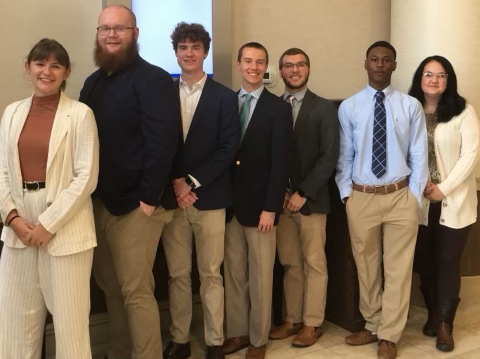 Columbus State's Model UN delgation: (left to right) Lizzie Williams, Michael Hurst,
Liam Berry, Spencer White, Austin Murray, Adrian Peterson, staff advisor
Columbus State's Model UN delgation: (left to right) Lizzie Williams, Michael Hurst,
Liam Berry, Spencer White, Austin Murray, Adrian Peterson, staff advisor
A major goal for each student is passing a resolution through one’s committee, which emphasizes the Model UN’s purpose: to develop delegates’ leadership, cooperative and collaboration skills. This is a momentous achievement if accomplished, as the task requires a host of skills including, but not limited to, debate and writing—skills that will serve them well in the future.
Through this process, several of the CSU delegates were able to get their sponsored draft resolutions passed—including Williams and Barry who represented Tunisia on the Economic and Social Council, and White and Murray on the General Assembly.
“Getting the majority of 149 students to agree with your proposal showcases your writing skills.” White said.
Barry, a junior from Roswell, Georgia, majoring in music education added that the collaboration element of the resolution process provided some invaluable perspectives.
“SRNUM was a great opportunity to collaborate with schools from across the region and be exposed to new viewpoints and opinions. Problem-solving with new individuals was very good for me and pushed me to think differently,” he noted.
Columbus State’s participation in the Model UN program is coordinated through the Department of Politics, Philosphy and Public Admininistration, which is based in the College of Letters & Sciences. Department chair Dr. Kimberly Gill and university budget and procurement specialist Raquel Aponte are the group’s faculty and staff advisors, respectively.
“I was inspired by our students’ passion and dedication as I watched them grow in confidence and as they sharpened their leadership and negotiation skills through debates and discussions of real-world problems,” Gill noted. “Our students had the opportunity to practice research, participate in public speaking, collaborate with other students, engage in critical thinking caucus dialogues, and sponsor accepted resolutions. I was thoroughly impressed with the level of professionalism and work ethic they displayed as they worked on building consensus and resolution writing.”
While the program’s roots are based around the department’s expertise in political science, legal studies and related fields, the Model UN program is a mutidisciplinary effort involving the Center for Global Engagement. It’s that university-wide support that White credits in making opportunities for CSU students like this possible—specifically citing the support of the College of Letters & Sciences dean, Dr. Annice Yarber-Allen; College of the Arts dean, Dr. Wanda Ebright; executive director of the Center for Global Engagement, Dr. Eric Spears, who is also the Mildred Miller Fort Foundation Eminent Scholar and Chair of International Education; and the Barbara C. and Clifford J. Swift III Distinguished Chair of the Joyce & Henry Schwob School of Music, Dr. Scott Harris.
Gill noted members of this spring’s competition team will be assisting with the High School Model UN competition next year using the skills they learned from their SRMUN experience to help mentor high school participants. She also said the department hopes to continue the university’s participation in the program in the fall, which will be based in Atlanta. Students interested in participating in future Model UN programs and opportunities should contact Gill for more information.
Jordan Stafford, a Spring 2023 intern in the Office of Strategic Communication + Marketing,
contributed this article.
Media contact:
Michael Tullier, APR, Executive Director of Strategic Communication + Marketing, 706.507.8729,
mtullier@columbusstate.edu