Columbus State University News
Veteran journalist Williams ’26 blends experience, master’s studies to open post-retirement doors
May 21, 2026
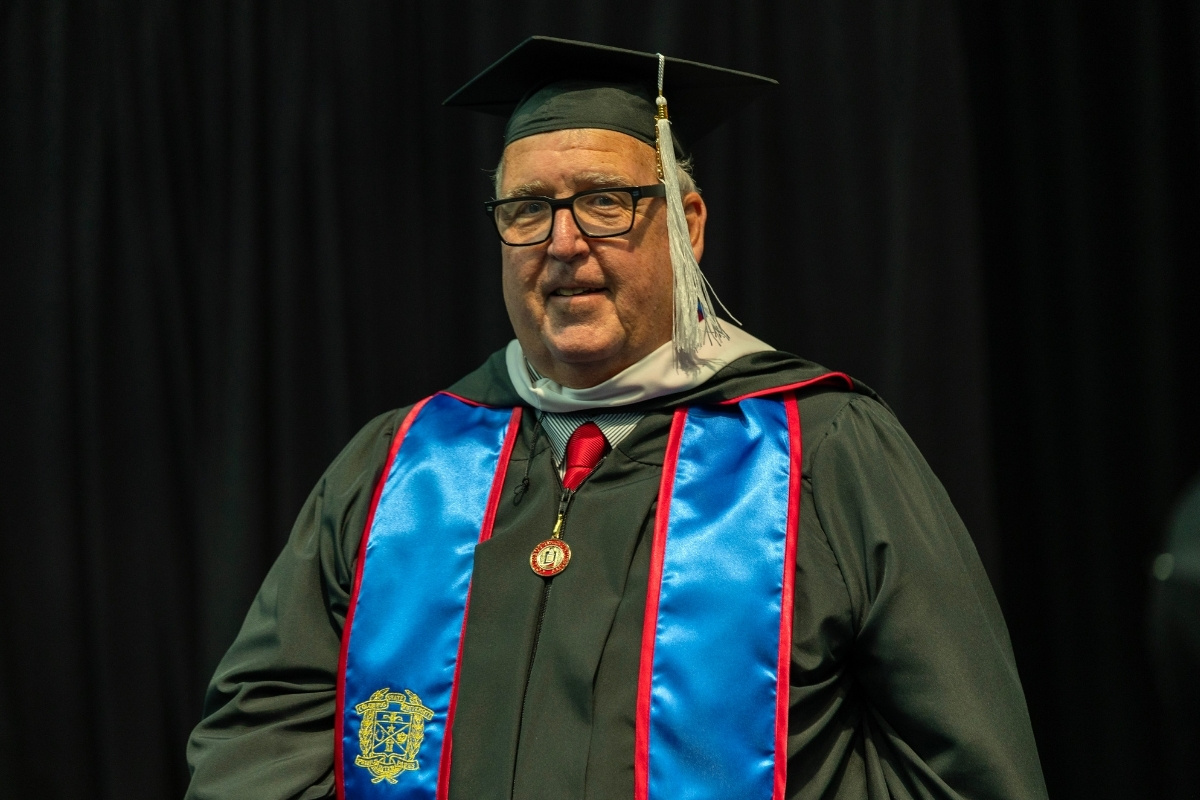
If you attended Columbus State University’s May 15 commencement and usually watch local Columbus-area TV news, one of the spring graduates might have made you pause, thinking, ‘Wait, where do I recognize that person from?”
The guy? That’s Chuck Williams, a local news staple on WRBL News 3.
Williams’ career spans 44 years—the first three decades as a news and sports reporter for several Alabama and Georgia newspapers, and concluding his print career at the Columbus Ledger-Enquirer in 2018. For the last eight years, he has worked as an investigative, breaking news and political reporter for Nexstar Media Group’s television station in Columbus.
When Williams began pursuing his master’s in communication in 2024, he was already a known variable in the Department of Communication. He had supervised practicums, reported from WRBL’s embedded news bureau, and was the department’s inaugural professional-in-residence. A self-described “news junkie,” he previously co-taught a course on political reporting in real time aligned with the 2024 presidential election cycle.
Williams is more than your average hometown news reporter. During his career, he has received multiple accolades from the Georgia Associated Press, the Georgia Press Association and the Georgia Association of Broadcasters.
During his sports reporting days (“I wanted to go to games, so I became a sportswriter.”), he interviewed PGA legend Jack Nicklaus alongside Paul Finebaum early in their careers, and NASCAR legend Richard Petty. He also supervised the Columbus Ledger-Enquirer’s coverage of the 1996 Atlanta Olympic Games. Before leaving print journalism, he served as the Ledger-Enquirer’s metro desk editor, interviewed military legends Gen. Norman Schwarzkopf and Gen. Colin Powell and authored the obituary of Columbus business, civic and philanthropic legend Bill Turner, which chronicled a half-century of Columbus history and became source material for other journalists throughout the country.
Since he joined WRBL, he’s been the station’s go-to for sit-down interviews with sitting governors, corporate titans and newsmakers of the day. One of his most memorable moments was reporting firsthand from the White House on U.S. Army Ranger legend Col. Ralph Puckett’s Medal of Honor ceremony, presided over by President Joe Biden. That coverage earned him and his WRBL coworker and news anchor Phil Scoggins a GAB Gabby Award.
Now 65 and considering his post-retirement career opportunities, Williams claims that earning a master’s degree has “moved the finish line and changed the race” professionally, opening new doors and creating new opportunities.
It took him 44 years since earning his bachelor’s degree in journalism at Troy University to return to a college classroom to earn his master’s degree. He ticked off the shifts during those four decades from typewriters to computers and from library research to the internet and artificial intelligence as classic examples of teaching an old dog a new trick.
Applying his vast experience to his academic pursuit
Williams, opting for an unconventional route, chose a comprehensive project rather than a traditional exam at the end of his graduate program. He credits Dr. Tiffany McBride, an assistant professor and one of his core Department of Communication instructors, with piquing his academic interest in crisis communication.
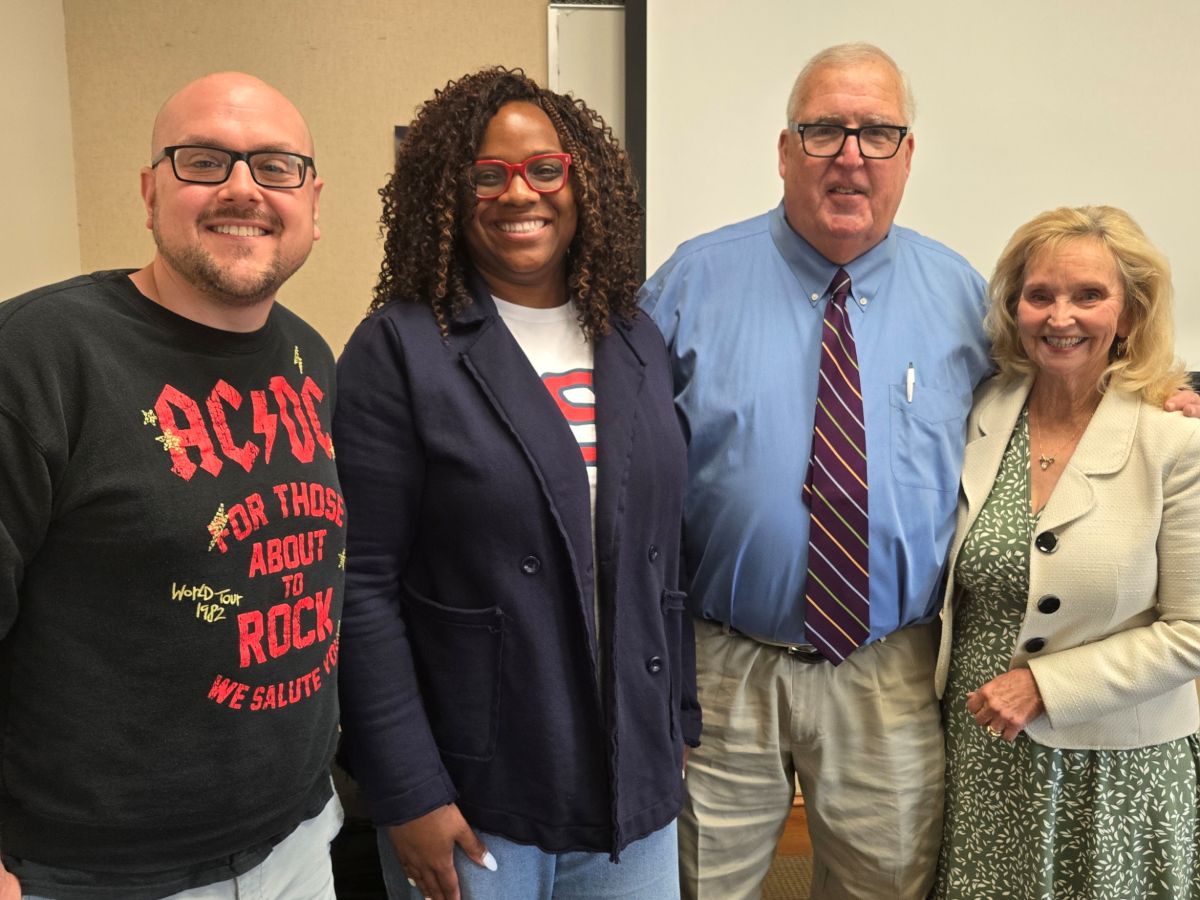
Williams with his graduate project mentors (left to right) Dr. Benjamin Baker (associate
professor), Dr. Tiffany McBride (assistant professor), Williams, and Dr. Danna Gibson
(professor).
Dr. Danna Gibson, another professor in the department, urged him to use his extensive background in corporate and public crisis reporting to benefit MercyMed. The faith-based nonprofit provides affordable, high-quality healthcare to underserved populations in Columbus, attending to their physical, spiritual, and emotional needs.
According to Gibson, tasking Williams with a research project acknowledged that he was “itching to be able to produce something substantive that would give back. This is the way prospective projects benefiting the community should go: [students] understand the theory but also be given the opportunity to put that into practice.”
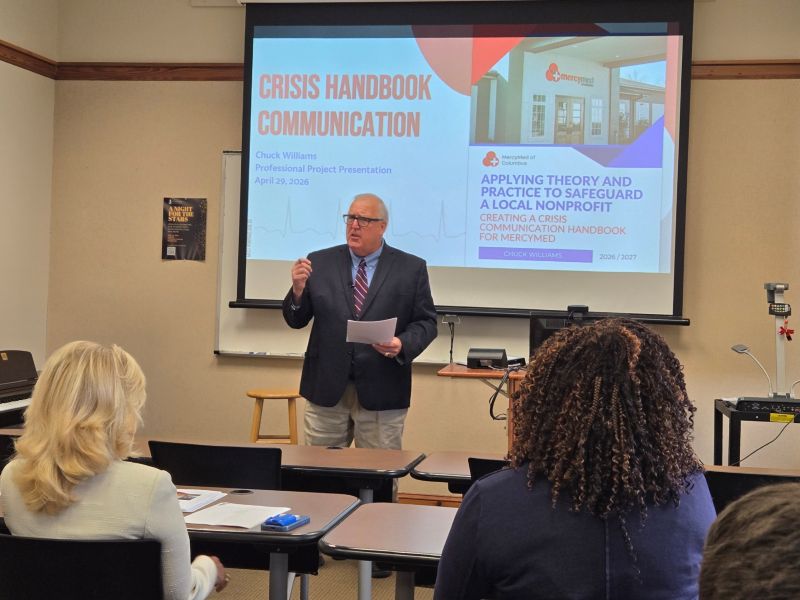 The crisis planning project (Williams pictured presenting his plan) showcased his
mastery of knowledge gained from his graduate studies—what he called “practical skills
from practical classes.” This encompassed a range of areas, from theoretical and ethical
strategic communication principles, applied data analytics and research skills, to
team dynamics and collaboration skills developed through group projects.
The crisis planning project (Williams pictured presenting his plan) showcased his
mastery of knowledge gained from his graduate studies—what he called “practical skills
from practical classes.” This encompassed a range of areas, from theoretical and ethical
strategic communication principles, applied data analytics and research skills, to
team dynamics and collaboration skills developed through group projects.
“I’m not a traditional student; I’m not even a traditional master’s student,” he claimed. “I already had the skills I’ve acquired throughout my career, but what I didn’t have was the ability to look at it from an academic lens. As I did that, I realized there is value, great value, in the theory and the academic side. There’s also value in people who can mesh that theory with practical experience.”
Through that lens, and using those principles as a guide, Williams examined MercyMed’s vulnerabilities across operations, medical services, funding and reputation that could escalate into crises—such as data breaches, staff misconduct, loss of donor support, and safety incidents involving patients and property, including weather-related events.
Williams’ project evolved into an evergreen “break-glass-in-case-of-emergency” playbook for the nonprofit—transforming years of reporting on public and corporate crises into a guide for the unthinkable.
‘The ticket to whatever happens next’
“I realized my mistake was waiting to start my master’s. Once life starts coming at you, it’s a lot harder to say, ‘hey, go back and get your master’s,’” he said. “I didn’t need a master’s degree to keep my job—I needed it to leave my job. That master’s [degree] is the ticket to whatever happens next.”
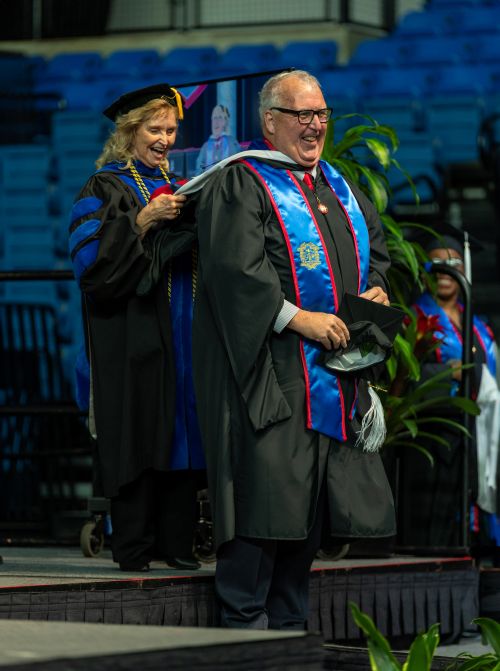 Williams (pictured at the May 14 Graduate Hooding Ceremony with Gibson) sees his master’s
degree as a ticket to multiple opportunities after his impending retirement—possibilities
he believes would be unattainable without the knowledge and credibility provided by
a graduate education.
Williams (pictured at the May 14 Graduate Hooding Ceremony with Gibson) sees his master’s
degree as a ticket to multiple opportunities after his impending retirement—possibilities
he believes would be unattainable without the knowledge and credibility provided by
a graduate education.
“This master’s degree and the doors it can possibly open have moved the finish line and in some ways may change the race,” he said, citing post-graduate and retirement plans to leverage his extensive journalism background, broad network and academic foundation in media relations and crisis communication, whether for consulting or even teaching.
In Georgia, adult learners like Williams benefit from the University System of Georgia’s 62 and Older Program, which removes financial barriers toward earning an undergraduate or graduate degree. The program fully waives tuition and mandatory fees for qualifying students for courses on a space-available basis, leaving students with textbooks and other course materials as their primary out-of-pocket expense.
As a “seasoned” 65-year-old with a brand-new college degree, he joked about being on Medicare and soon qualifying to draw Social Security. As a rabid Columbus Clingstones fan, he beamed about the bobblehead the team will distribute in his honor in August. But it’s his Columbus State master’s degree that he credits with deepening his connection to the community he’s called home since 1989.
He’s also proud to join the network of fellow CSU graduates, which includes his daughters: Joy Beth Williams Brown, a 2016 early childhood education alumna, and Jennifer Vaughn Lynch, who earned her MBA in 2013.
“I’ve always thought Columbus State University was special, but I never felt like a real part of it. When I walked across that stage, I became part of it. I’ve seen the good this university, in concert with this community, has done. I’ve witnessed firsthand the Uptown Columbus transformation, which wouldn’t have happened without Columbus State University. I see people in jobs living here—middle-class working folks who wouldn’t be here without their CSU education,” he said.
“I’m now a piece of that—a little piece, but a piece, and that’s important to me.”
Media contact: Michael Tullier, APR