Columbus State University News
New Moore Institute to steward the American military experience’s ‘distinctive culture within our democracy’
November 14, 2026
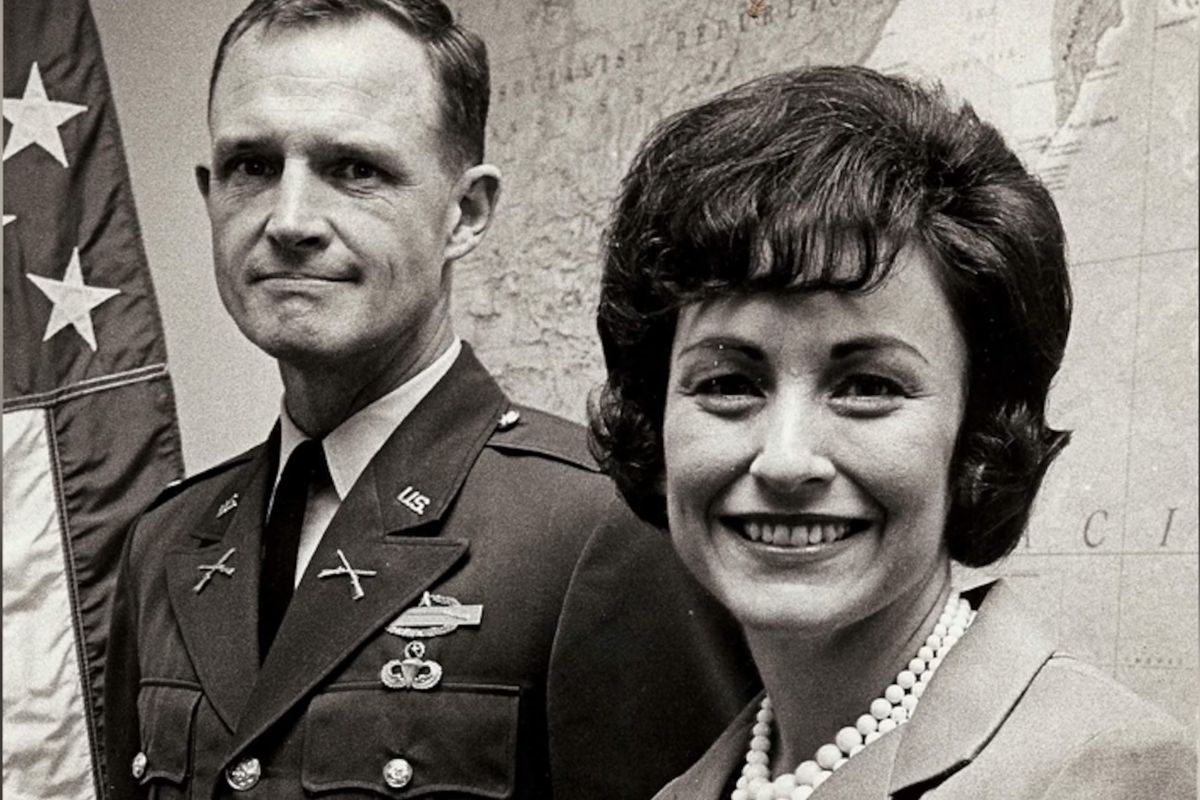
Columbus State University concluded Veterans Day with an event on Nov. 11 officially naming the Lt. Gen. Harold & Julia Moore Institute for the Study of the American Military Experience. The institute is one of only a handful nationwide dedicated to documenting, preserving and providing access to resources on U.S. military history.
The university announced the Moore Institute’s formation in October, after the University System of Georgia Board of Regents approved naming it in honor of the revered military couple. Through the institute, Columbus State aims to expand its existing military history programs, which foster informed public discourse, preserve critical historical records and provide valuable educational opportunities.
“Hal and Julie [Moore] represent the full scope of the American military experience: the steadfast leadership of those who serve in uniform on the battlefield, and the resilience required to support military families back at home. And that is the heart of this institute,” said Pat Donahoe, the university’s chief operating officer, a retired U.S. Army major general and a former commanding general of the Army’s nearby Maneuver Center of Excellence and Fort Benning.
As the Moore Institute’s inaugural director, Dr. David Kieran aims to set Columbus State apart by focusing on the “American military experience.”
“The term ‘American military experience’ is intentional,” said Kieran, who has served as Columbus State’s Col. Richard R. Hallock Distinguished University
Chair of Military History since 2022. “We know that the American military experience isn’t just what happens to soldiers,
sailors, airmen and Marines when they are deployed and they are downrange. The American
military experience is what happens to military families … it’s what happens in military
communities like the one we live in. ... [it] touches the pastors of our churches,
the teachers in our schools. We know that the American military experience is vast,
and we have set our mission of trying to capture that experience as broadly and deeply
as we can.”
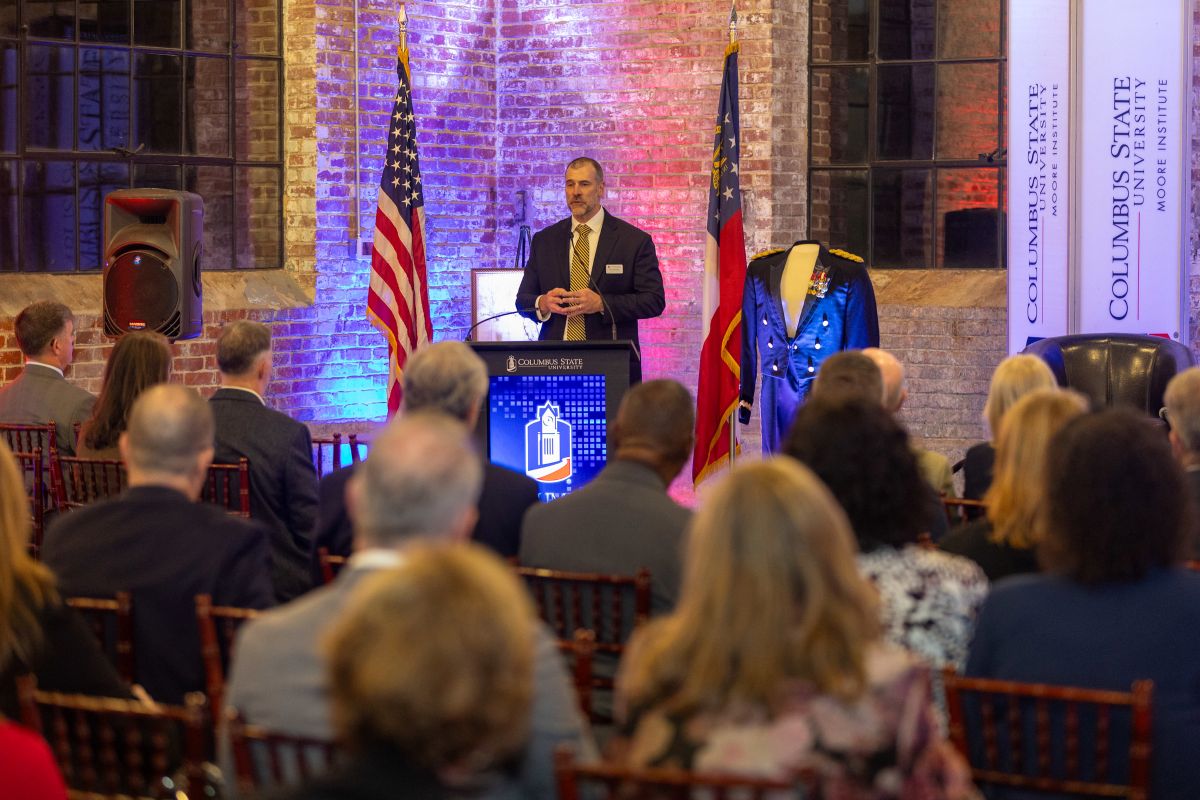 Dr. David Kieran addresses the audience at the Moore Institute naming celebration.
Through his leadership of the university’s Hallock Endowment for Military History, Kieran has helped to establish Columbus State as a destination where students, academicians,
military professionals and historians can examine the experiences of those who serve
and the broader impact of the military on American society. An author, editor and
coeditor of six books, he is known internationally for his expertise in military history
and served as the 2024-25 Harold Keith Johnson Chair at the U.S. Army War College.
Moores: ‘Heroism,’ ‘compassion’ personified
In explaining the Moores’ selection for the institute’s honorary naming, Kieran said,
“There’s no family in the United States that captures what we mean when we talk about
the American military experience more than the Moore family.” He pointed to examples
of Lt. Gen. Moore’s battlefield heroism and his leadership as an Army change agent.
He also lauded the compassion Julie Moore showed to her fellow Army wives and mothers,
especially those of fallen soldiers.
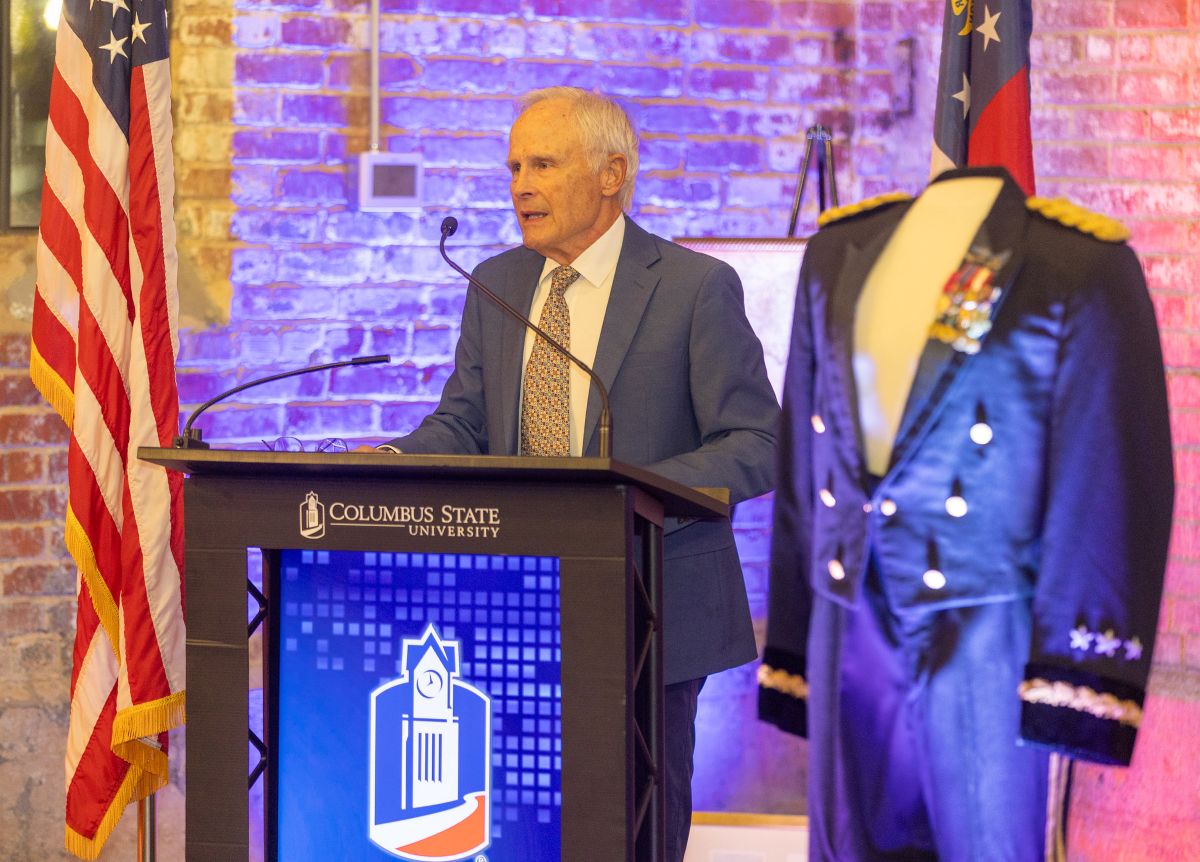 Greg Moore speaks at the Moore Institute celebration, with one of his father's uniforms,
on loan from the National Infantry Museum, in the foreground.
To highlight those contributions, Greg Moore, the eldest of the Moores’ five children,
spoke to the importance of the institute’s mission to honor military culture.
“The American military is more than an institution of national defense; it is a distinctive culture within our democracy. It takes citizens from every walk of life and asks them to accept extraordinary obligations, including the willingness to give their lives for one another,” Moore said.
“Understanding how military culture develops, how it shapes character and how it affects the families and communities built around it is essential to understanding the American experience itself,” he continued. “That’s why this institute is so critical.”
Moore also emphasized the importance of the Moore Institute’s mission to demystify the American military experience for people who have never worn a uniform. The Pew Research Center estimates that only about 6% of American adults are military veterans, while fewer than 1% are currently on active duty.
He challenged: “How can Americans who have never served or lived a military life better understand the men and women who stand at risk on their behalf? This understanding is the essential connection and the essential mission within the Moore Institute between the American military and the American people that my parents loved, honored and worked throughout their lives to strengthen.”
Throughout the program, Moore considered his parents’ military legacy and its role in shaping the modern American military experience. For his father, that experience centered on the “extraordinary bond that exists between soldiers”; for his mother, it was defined by “the anxiety, courage, sacrifice and resilience that Army life demands.”
“The Army shaped them both. And together they helped shape the Army communities around
them,” he said. “What makes their experience meaningful is not that it was unique
to them—quite the opposite. The Moore family story is an expression of the extraordinary
experiences shared by generations of American military families. And it’s now given
real permanence here at Columbus State.”
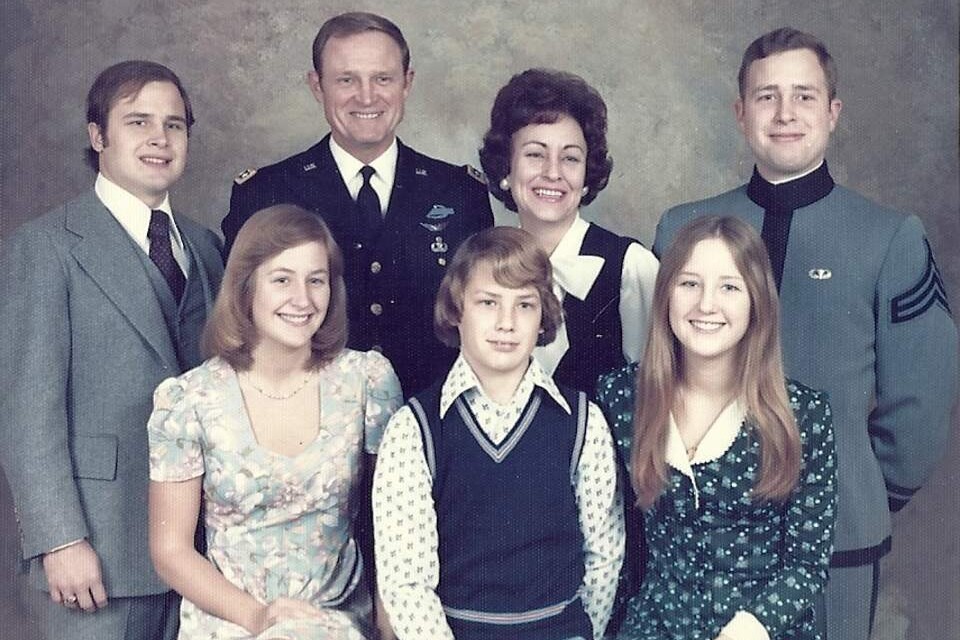 The Moore family in 1975: (front row, left to right) Julie, David and Ceci; (back
row, left to right) Greg, Hal, Julie and Steve (photo courtesy of the Moore family)
Moore also noted that his father’s 32 assignments and the family’s 26 Army-related
moves shaped him and his siblings as military children.
“You develop uniquely, as a military child, resilience and adaptability. Because if you can’t move and quickly make friends, if you can’t move and figure out where you are and what the culture and what the rules are, you’re going to be lost,” he reflected. “And so, you learn quickly where you are, how to figure out what life is.”
Some of Moore’s remarks came during a panel on life in a military family, which also featured Columbus native Jeannie Puckett, wife of the late Col. Ralph Puckett. A legendary U.S. Army officer and veteran of both the Korean and Vietnam wars, he earned the Medal of Honor. She discussed the challenges military spouses and parents share, particularly during extended absences and deployments.
“You put on a good front in front of your children,” she recalled of her experience as an Army wife and mother. “Nobody really understands that until you walk in those shoes. And so, the minute he left [for Vietnam], there was this feeling of real responsibility—of knowing that I would have to carry on if he didn’t come back.”
Returning to the fact that 94% of Americans have never served in the military, Puckett said that the gifts of citizenship and freedom obligate everyone to serve in some way.
“I think we’re all obligated to give back to this country in some way—if not the military,
in your community. Serve somewhere,” she said, recounting advice she shared with civilians
and veterans alike at the ceremony where her husband received the Medal of Honor.
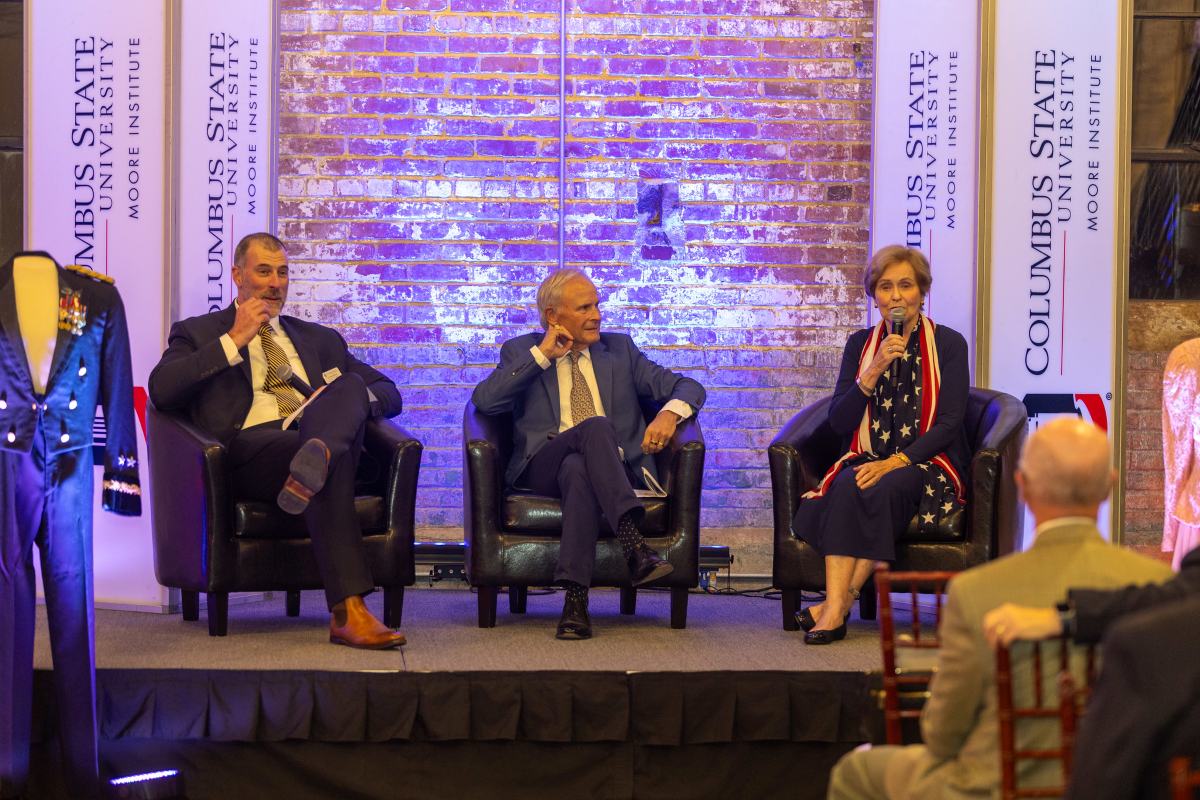 Jeannie Puckett (far right) makes remarks during a panel that included Dr. David Kieran
(far left) and Greg Moore (center)
Building on years of philanthropy, advocacy
The Moore Institute grew from programming funded by the Col. Richard R. Hallock Endowment for Military History, established in 2010 in honor of the decorated World War II parachutist who later advised Defense Secretary James Schlesinger. For nearly two decades, the Hallock Endowment has brought a range of thought leaders on military history and national security, including general officers, defense intellectuals, policymakers and leading military historians to Columbus State to engage with its students and the community.
The Hallock Endowment also established the endowed university chair Kieran holds, one of only about a dozen such chairs in military history in the country. Kieran is the second person to hold the title at Columbus State; the first was Dr. Dan Crosswell.
Myriam Johnson Hallock has continued supporting the endowment named for her late husband while broadening the university’s focus on military history. In early 2026, the former career foreign service officer with the U.S. Information Agency established the Myriam & Richard Hallock Distinguished Lecture in Foreign Policy and National Security Endowment.
Alongside its Hallock-funded educational and outreach programs, Columbus State has long housed nationally significant collections documenting military history from the American Revolution to the present. Recent notable additions include the papers and artifacts of Reagan-era Secretary of the Army John O. Marsh, pioneering Army social worker James Martin, and Robert McNamara “whiz kid” Pierre Sprey.
The university’s emphasis on preserving military history—based in the Thomas Archives & Special Collections, fostered through the Hallock Endowment, and now advanced by the Moore Institute—has also received congressional support. This includes $175,000 in bipartisan federal funding legislation for military history preservation, secured in early 2026 with help from U.S. Senators Jon Ossoff and Rev. Raphael Warnock, both of whom represent Georgia.
Charitable contributions from the Donahoe and Foster families recently established two endowments: the 1st Lt. William A. Donahoe Jr. & Cpl. Charles Foster Endowment for the Support of American Military History Preservation and the 1st Lt. William A. Donahoe Jr., U.S. Army, Military Oral History Endowment. The university recently partnered with the Library of Congress’ Veterans History Project to contribute to the nation’s oral history collection and expand its own regional military history collection. Several university ROTC cadets and other volunteers continue to collect these stories.
“Through the oral history collection that we’re building—through the stories we are gathering not just from the generals, not just from the secretaries of the Army, but from the wives, the children, the members of our community—we will tell the full story of the American military experience,” Kieren said. “It’s not an exaggeration to say that in a few years, it will be impossible for a serious scholar of American military history to write a history of the post-Vietnam U.S. Army and not come to Columbus State University to conduct research using our materials.”
Kieran noted that the university’s proximity to Fort Benning and other military history sites, including the National Infantry Museum and the National Civil War Naval Museum, strengthens the Moore Institute’s work and collaboration.
“The military’s centrality to this community offers Columbus State University the opportunity to be an international leader in the study of the American military and American military history,” he said. “But more importantly, it confers upon us the obligation to be the stewards of that history and the leaders in an international conversation about what that history means and how it should guide us in the future.”
Additional photos from the Moore Institute naming celebration are available for download from the university’s Flickr account.
Media contact: Michael Tullier, APR