Columbus State University News
New Pezold Center for Emergent Technology to reshape Georgia’s tech education, workforce
October 12, 2026
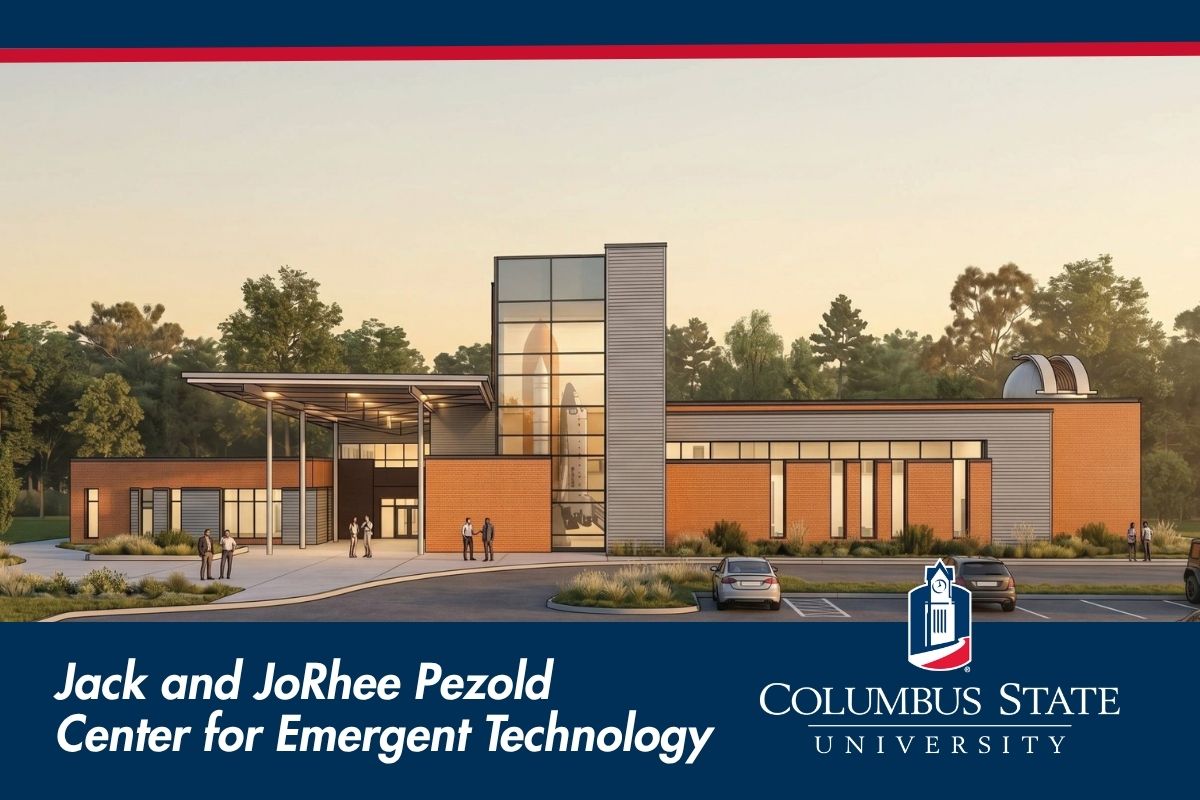
Landmark support from Jack and JoRhee Pezold is elevating Columbus State University’s impact on STEM education, technology innovation and workforce development in Columbus, across Georgia and beyond.
The university will break ground early next year on the 36,000-square-foot building that will serve as the new home for CSU’s Coca-Cola Space Science Center and its expanding Robotics Engineering program. After the University System of Georgia’s Board of Regents approved it last week, the building will be named the Jack and JoRhee Pezold Center for Emergent Technology in recognition of their landmark donations to the project.
The Pezolds invested $6 million in the project; $4 million of their gift will fund the building itself. Another $2 million will permanently endow a distinguished institute chair—a dynamic technologist and economic development leader to work from the building. The Pezolds chose to name the endowed chair after Dr. Jim and Nancy Buntin.
“This project, and the Pezolds’ unwavering support of Columbus State University, are game changers for our students,” explained Dr. Stuart Rayfield, the university’s president. “This significant contribution—one of the largest outright gifts in our history—cements Columbus State’s position as a statewide engine for economic development, industry recruitment and high-demand STEM career preparation. It directly aligns with our strategic priorities to empower transformative leadership and drive regional innovation.”
Longtime Columbus business owner Jack Pezold views the couple’s donation as an investment in the Chattahoochee Valley’s economy.
“By treating innovation as a discipline and encouraging a transformative mindset, this center will position Columbus State to directly fuel regional industry recruitment and job creation,” he said. “It is truly an honor that the University System of Georgia Board of Regents chose to associate JoRhee and me with the center in this way, especially given the integrated talent pipeline it will create for the region for decades to come.”
By embedding real-world applied learning directly into the curriculum, Columbus State is ensuring its graduates enter the market as problem-solvers ready to lead from day one. It also strengthens an ecosystem that starts in kindergarten, continues through Columbus State, and extends into students’ post-college careers:
- K-12 STEM Integration: Partnering with the Muscogee County School District to support robotics teams, support youth STEM programs, and introduce the 17,000-plus school district students visiting the Coca-Cola Space Science Center annually to higher learning opportunities at Columbus State.
- Applied Engineering Labs: Expanding instructional laboratories for Columbus State’s Robotics Engineering majors, whose enrollment has grown from six students when the program launched in 2019 to more than 100 undergraduate and graduate students today. Graduates have gone on to work at local companies such as Pratt & Whitney, as well as cybersecurity, artificial intelligence and defense companies across the country.
- Defense and Industry Partnerships: Strengthening research and testing collaborations with nearby Fort Benning and local advanced manufacturing sectors to better prepare graduates for immediate careers.
Columbus State announced plans for the center in June 2025, after the Georgia Assembly approved the state’s FY26 budget. The center will be built on its Main Campus along East Lindsay Drive, parallel to Interstate 185. Construction is scheduled to begin in Spring 2027, with the center expected to become fully operational in Fall 2028. It will bring together Columbus State’s rapidly growing Robotics Engineering program, the relocated and expanded Coca-Cola Space Science Center, and a new Institute for Emergent Technology under one roof.
Since opening in 1996, the Coca-Cola Space Science Center has inspired visitors of all ages to look to the stars. As Georgia’s only science center and museum dedicated to astronomy and space science experiences, it serves nearly 40,000 students and public visitors each year. Its galleries, aerospace artifacts and science education programs have fostered an appreciation for science and technology and strengthened scientific literacy across local and academic communities.
January 2023 Coca-Cola Space Science Center Expansion Announcement
The Pezold Center for Emergent Technology project is funded through a partnership combining $12.2 million in state appropriations, $4 million in federal grants, $2 million in special-purpose local option sales tax (SPLOST) funds from the Muscogee County School District, and the private investments from the Pezolds. The $22.2 million building project will be Columbus State’s first new state-funded academic building in more than two decades.
“This building exemplifies this community’s commitment to partnerships and Columbus State University’s role in educating students who will advance the technological needs of our region,” said Muscogee County School District Superintendent Dr. David Lewis when the building was announced. “I look forward to expanding our relationship with CSU, and our ability to inspire the next generation of tech-savvy students through this tremendous facility.”
Redefining STEM education, workforce development
At the heart of the new center will be an Institute for Emergent Technology, which aims to move beyond traditional academic models and build an agile workforce pipeline for Georgia’s fastest-growing economic sectors. Instead of following standard collegiate approaches, the institute will create a direct link between higher education and industry.
“The rise of technologies such as cybersecurity, artificial intelligence, robotics and advanced computing is transforming nearly every industry and driving unprecedented workforce demand,” Rayfield explained. “To meet these needs, higher education must evolve beyond traditional curricula, lecture-based instruction and research-focused laboratories.”
That evolution, according to Rayfield, is represented in Columbus State’s Institute for Emergent Technology: an industry-responsive, highly adaptive program focused on practical, hands-on learning that prepares students to succeed in the workforce immediately. The institute will use a hybrid faculty model, pairing traditional faculty from disciplines across the university with industry practitioners to bring authentic, real-world experiences directly into the classroom rather than waiting for students to gain them through internships or other external experiences.
Integrating an industry perspective
To equip the university with the resources and framework to recruit an executive director boasting extensive sector experience, the Pezolds made an additional $2 million philanthropic investment to permanently endow a distinguished institute chair. They chose to honor Dr. Jim and Nancy Buntin by naming the endowed directorship after the couple.
The Dr. Jim and Nancy Buntin Distinguished University Chair in Emergent Technology honors the two prominent civic leaders known statewide for their servant leadership and dedication to educational excellence.
After serving as superintendent of the Muscogee County School District, Dr. Buntin helped establish the Muscogee Educational Excellence Foundation, a highly impactful nonprofit that has awarded millions of dollars to outstanding local educators. Nancy Buntin, a longtime CSU Foundation trustee, served on Synovus’ leadership team when Fortune magazine named the company to its “100 Best Companies to Work For” list from 1998 to 2006.
“The Buntins are wonderful community advocates and champions for education who have made a tremendous impact in so many different ways,” said JoRhee Pezold. “Our hope is that this position will—like the Buntins—also make a meaningful and lasting difference in Columbus.
The Buntin Distinguished University Chair and the institute itself will directly target high-wage, high-impact career pathways across the Chattahoochee Valley and Georgia. Rayfield noted that the endowed chair position itself marks a shift from the traditional academic dean model toward one that continuously adapts to rapid market changes.
“The Institute for Emergent Technology’s programs will directly align with workforce priorities identified by the Georgia Office of Economic Development’s High-Demand Career Initiative. The initiative identifies occupations that are in demand, offer above-average entry-level wages and provide strong pathways to successful careers in Georgia,” Rayfield said. “The Buntin Distinguished University Chair will be an innovator with deep industry experience who can bridge higher education, workforce development and emerging technology.”
About the Pezolds
Prominent entrepreneur and philanthropist Jack Pezold and his wife JoRhee have built a vast hospitality and business organization that has shaped the Chattahoochee Valley economy for decades. They moved to Columbus in 1980 and began building their business with six regional McDonald’s locations. At its peak, their umbrella company, Pezold Management, owned and operated 22 McDonald’s restaurants in the area. He has since sold the restaurants, but his remaining corporate investments include Valley Hospitality, which operates several local hotels and venues, and Denim North America.
Just as they have made their mark in Columbus’ business community, they have done the same philanthropically throughout the region. At Columbus State, they have long supported the university’s mission and generations of its students.
Through the Jack and JoRhee Pezold Division of Keyboard Studies, they have supported scholarships, graduate assistantships, students’ competitive international travel and other initiatives that enhance the piano and organ programs within the Joyce and Henry Schwob School of Music. They have also supported campus life and student engagement initiatives, students’ artistic endeavors, and student-athletes and athletics programs, among other areas.
Mr. Pezold served on CSU’s Foundation Board of Trustees, which guides the university’s fundraising efforts and oversees its endowment investment strategy. He is now a trustee emeritus.
Media contact: Michael Tullier, APR or John Lester