Columbus State University News
Pezold Center groundbreaking signals launch of ‘transformative investment’ in STEM education, workforce development
November 5, 2026
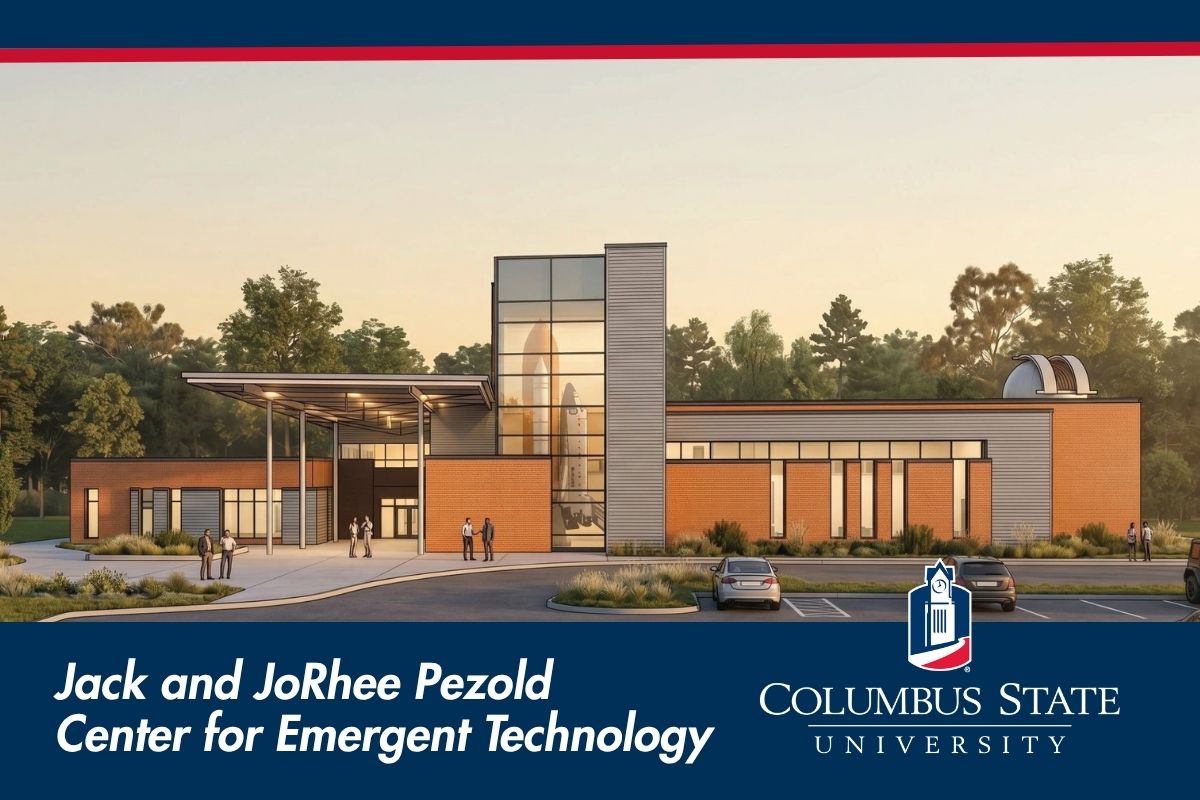
Calling it a “transformative investment in our community,” Columbus State University President Dr. Stuart Rayfield and others took part in a ceremonial groundbreaking on Nov. 4 for the Jack and JoRhee Pezold Center for Emergent Technology.
The $22.2 million Pezold Center is scheduled to open in fall 2028 on the university’s Main Campus, parallel to Interstate 185 and next to the Elizabeth Bradley Turner Center. It will house Columbus State’s Robotics Engineering program, its Coca-Cola Space Science Center and the forthcoming Institute for Emergent Technology.
“This facility is an excellent example of how Columbus shines: through public and private collaboration,” Rayfield said of the university’s first new state-funded academic building in more than two decades. “It is an investment in the future of robotics, space science and—most importantly—workforce development for our region and all of Georgia.”
Rayfield said the Pezold Center will serve as a hub for artificial intelligence, robotics, cybersecurity and yet-to-be-discovered innovations, creating academic, experiential learning and career pathways for Columbus State students. It will upgrade spaces and labs for undergraduate and graduate Robotics Engineering students and relocate the Coca-Cola Space Science Center to Main Campus, where it can expand its footprint and mission. Since 1996, as Georgia’s only science center and museum dedicated to astronomy and space science experiences, the space science center has inspired more than 1 million students and visitors from around the globe to look to the stars.
Dr. Shawn Cruzen, executive director of the Coca-Cola Space Science Center and a professor of physics and astronomy, credited the center’s move as “a giant step forward” for the university’s ability to provide technology and fundamental science programs to area K-12 and college students.
“We’re leveraging this opportunity to build an ecosystem for preparing students in science, technology, engineering, mathematics, and particularly the areas of what we call ‘emerging technologies’—disciplines that are coming online that are very new, bleeding edge,” Cruzen said. “The Pezold Center will be dedicated to inspiring students to pursue those fantastic new careers while deepening their understanding of the technology principles behind them.”
Cruzen noted that the space science center’s footprint will grow by roughly 50%, giving it room to move all its popular features, programs and exhibits to its new home. The larger space will also expand its capacity to host new programs and form new partnerships that advance the Pezold Center’s mission.
By further embedding real-world applied learning directly into the academic curriculum, Columbus State is ensuring its graduates enter the market as problem-solvers ready to lead from day one. It also strengthens a technology education ecosystem that starts in Muscogee County School District’s kindergarten classes, continues through Columbus State, and extends into students’ post-college careers:
- K-12 STEM Integration: Partnering with the Muscogee County School District to support robotics teams and youth STEM programs, while introducing the 17,000-plus school district students visiting the Coca-Cola Space Science Center annually to higher learning opportunities at Columbus State.
- Applied Engineering Labs: Expanding instructional laboratories for Columbus State’s Robotics Engineering majors, whose enrollment has grown from six students when the program launched in 2019 to more than 100 undergraduate and graduate students today. Graduates have gone on to work at local companies such as Pratt & Whitney, as well as cybersecurity, artificial intelligence and defense companies across the country.
- Defense and Industry Partnerships: Strengthening research and testing collaborations with nearby Fort Benning and local advanced manufacturing sectors to better prepare graduates for immediate careers.
“We cannot know exactly what the future of technology will look like. But we can choose how we prepare for it,” Rayfield explained. “We can give our students the knowledge, the skills, the curiosity and the confidence to navigate that future—not simply to adapt to change, but to help lead it.”
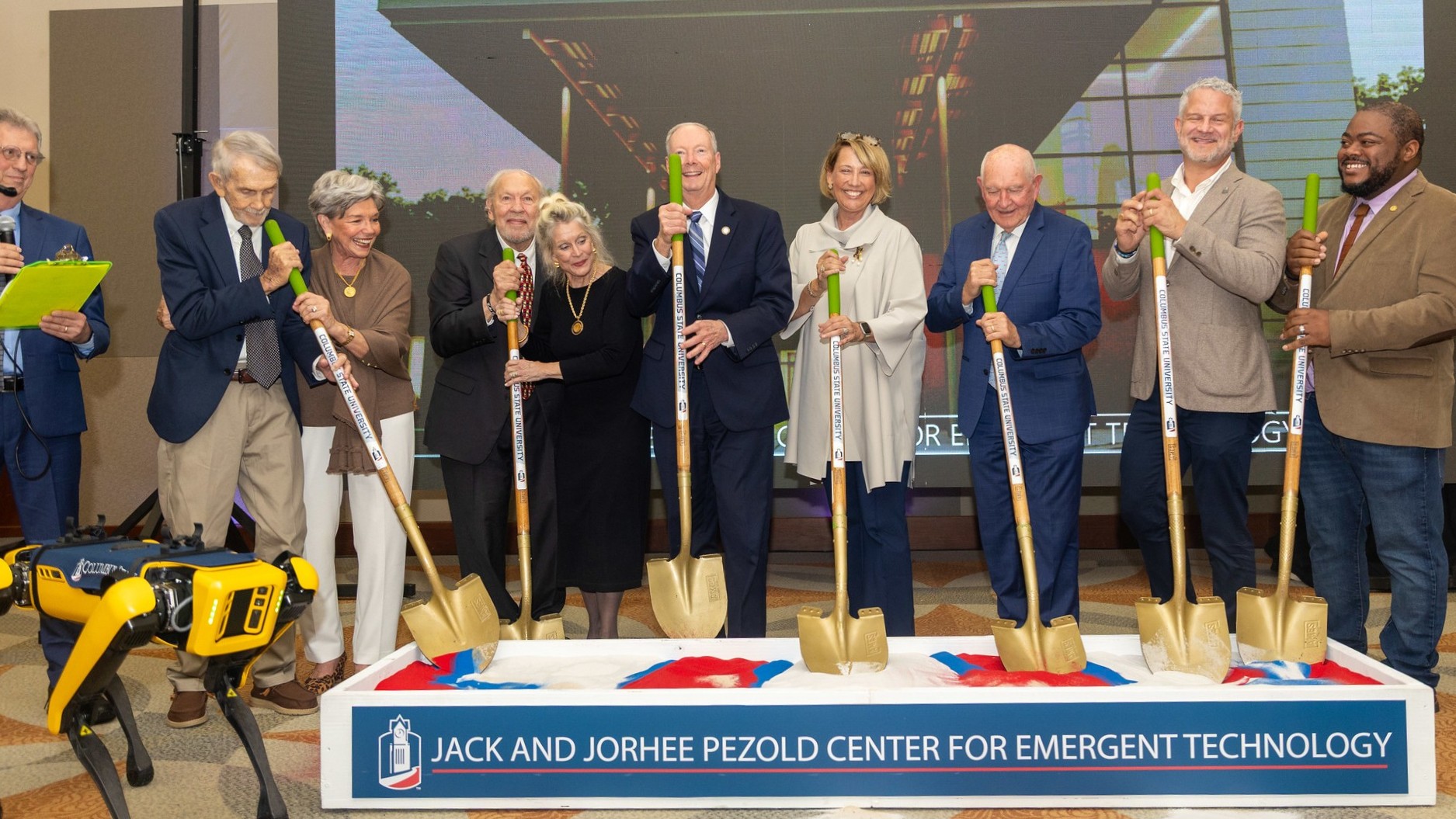 Helping to break ground on the new Pezold Center were (left to right) Dr. Shawn Cruzen,
Dr. Jim and Nancy Buntin, Jack and JoRhee Pezold, Muscogee County School Superintendent
Dr. David Lewis, Columbus State University President Dr. Stuart Rayfield, University
System of Georgia Chancellor Dr. Sonny Perdue, Chris Woodruff of the CSU Foundation
and the J.W. and Ethel I. Woodruff Foundation, and Columbus State alumnus Dr. John
Hood ’14.
‘…more than bricks and mortar.”
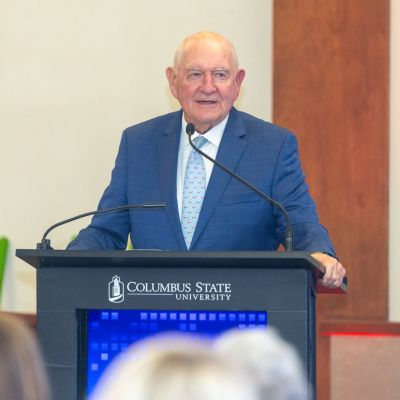 USG Chancellor Dr. Sonny Perdue (pictured) echoed those sentiments, outlining how the Pezold Center aligns with the
system’s approach to technology education and economic development.
“Technology is changing the way we learn, the way we teach,” Perdue said. “We want to make sure our graduates from Columbus State leave ready to lead in the workforce. The Pezold Center will provide students with the very best in robotics and space science education. This means our graduates will have market-ready skills and that we’re investing in efforts that drive economic development.”
Perdue went on to laud the Pezolds’ philanthropic investment and the new center as “building the workforce of tomorrow. We’re preparing students for high-demand careers here in Georgia and enhancing quality of life and prosperity for every Georgia family. That’s really the essence of the mission of the University System of Georgia. By educating the next generation of leaders in technology, robotics and space science, we’re ensuring that Georgia remains a top state for talent.”
Another pillar of the Pezold Center’s STEM education and workforce development vision will be its role in continuing to foster the university’s longstanding education and outreach collaboration with the Muscogee County School District.
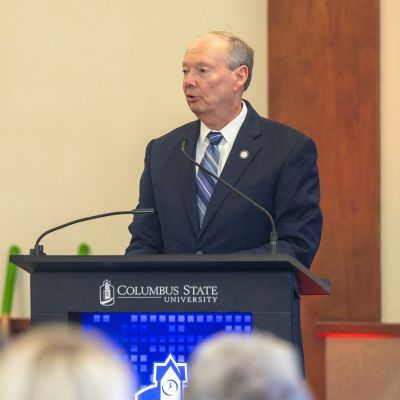 “This center is more than bricks and mortar. It is about creating environments where
[K-12] students can explore their interests, develop their talents and prepare for
opportunities that may not even exist today,” said Dr. David Lewis (pictured), superintendent
of the Muscogee County School District.
Lewis pointed to the district’s existing K-12 STEM education programs in partnership with the Coca-Cola Space Science Center and how the Pezold Center will further enhance collaboration between the university’s Robotics Engineering program and the 75-plus robotics teams across the school district.
“…this collaboration builds on the strong partnership between the Muscogee County
School District and Columbus State University that creates a pathway from kindergarten
through postsecondary education,” Lewis continued. “We often talk about preparing
students for the future. This partnership allows us to do something even better: give
them the tools, experiences and opportunities to help shape that future.”
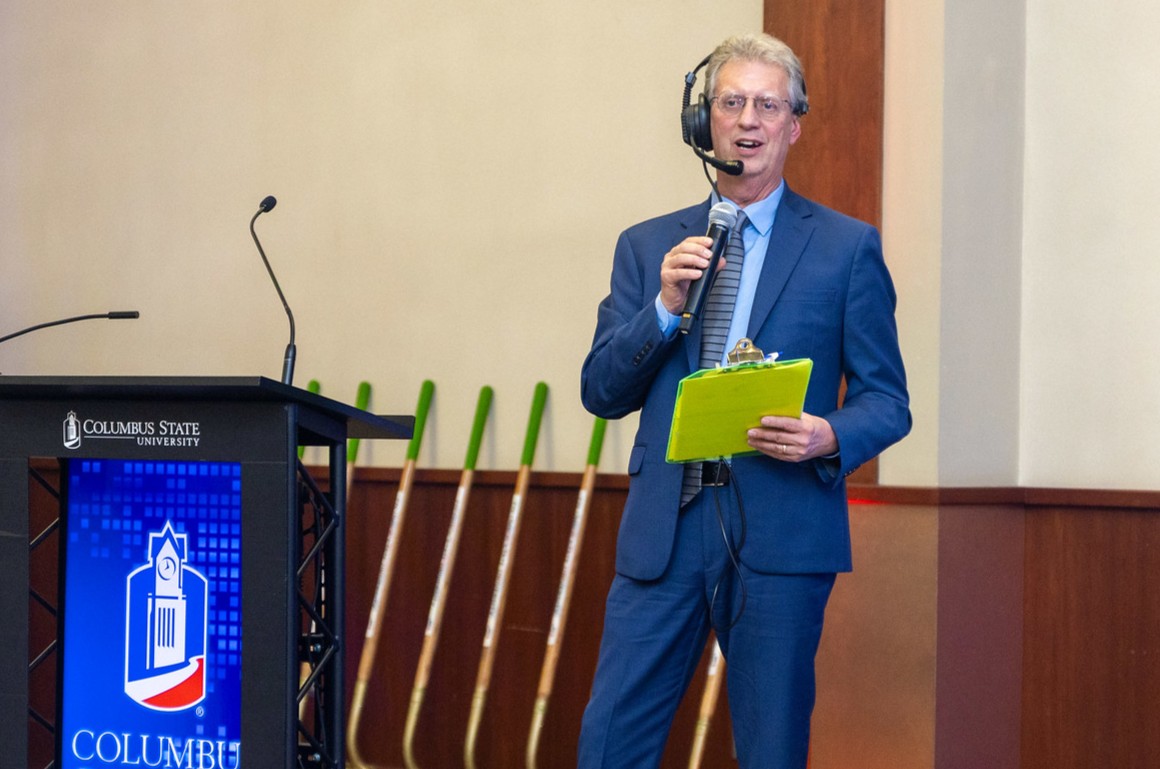 Coca-Cola Space Science Center Executive Director Dr. Shawn Cruzen donned a misson
control-style headset for a "Go-No Go" precursor to the groundbreaking ceremony.
‘…creating opportunities for future generations.’
Rayfield explained that the $22.2 million Pezold Center initiative was made possible through a variety of sources: $12.2 million in state funding, $4 million in federal funding and $2 million in educational special-purpose local option sales tax (SPLOST) funds from the Muscogee County School District. But it was the $4 million in private support from the Pezolds, Rayfield said, that moved the center’s vision from concept to reality.
“Jack and JoRhee’s gift to the Pezold Center for Emergent Technology represents more than a financial contribution,” Rayfield explained. “It represents a belief in the power of education, the promise of innovation and the importance of creating opportunities for future generations.”
Their contribution to the building project ranks the Pezolds—prominent entrepreneurs and philanthropists in Columbus—among the most significant charitable investors in the university’s history, Rayfield said, crediting their support with “uplift[ing] virtually every corner of our university.” It also prompted the University System of Georgia’s Board of Regents to name the center in their honor.
The Pezolds didn’t limit their support to the center’s construction. They made an
additional $2 million philanthropic investment to permanently endow a distinguished
institute chair. They chose to honor two prominent civic leaders—former Muscogee County
School District Superintendent Dr. Jim Buntin and retired Synovus executive Nancy
Buntin—by naming the endowed directorship after the couple.
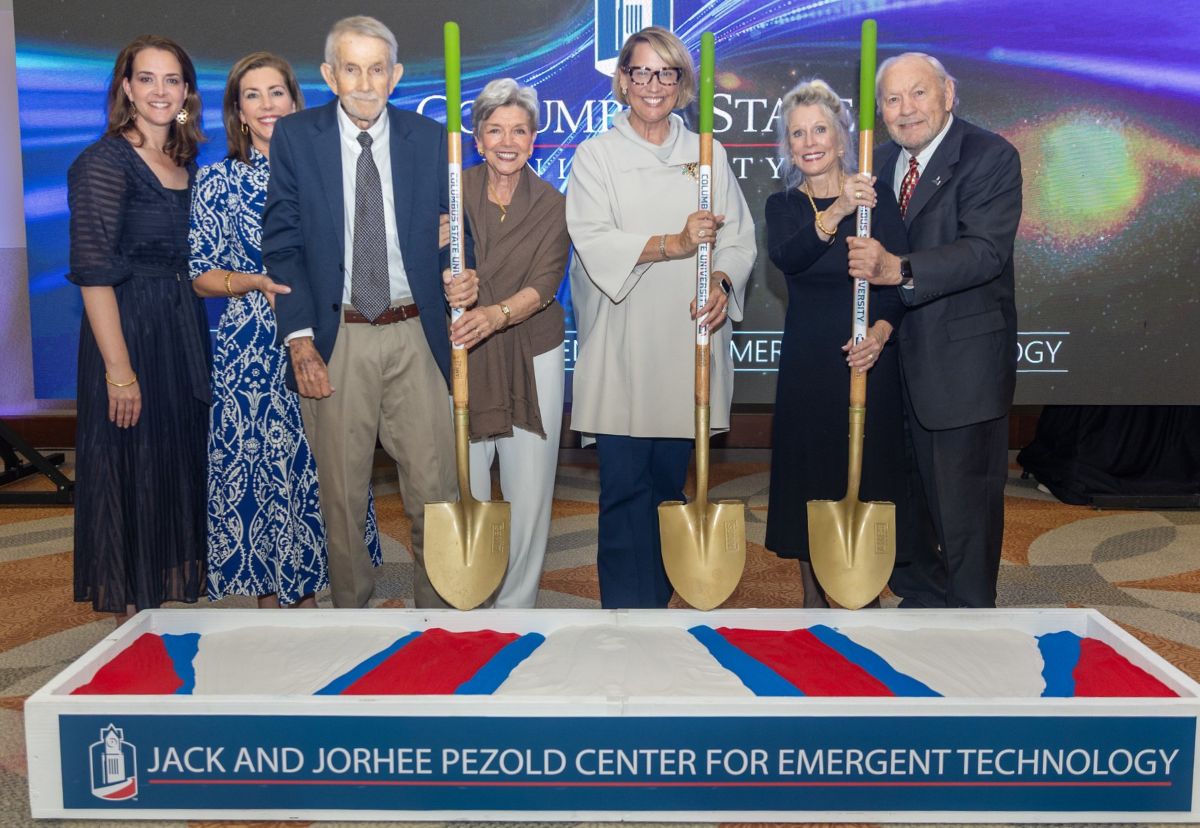 President Stuart Rayfield (center) with (right) JoRhee and Jack Pezold (left) and
(right) Dr. Jim Buntin, Nancy Buntin and their daughters Jenny Lynn Buntin and Tish
Buntin Shirley.
The endowed Buntin Distinguished University Chair position, Rayfield noted, marks
a shift from the traditional academic dean model toward one that continuously adapts
to rapid market changes. She described the best candidate for that role as “someone
who is an innovator with deep industry experience and who can bridge higher education,
workforce development and emerging technology.” Leading the Institute for Emerging
Technology from the Pezold Center, this director will target high-wage, high-impact
career pathways across the Chattahoochee Valley and Georgia.
In her groundbreaking remarks, Rayfield described the Pezolds’ support as “infectious” among other Columbus State contributors. She recognized the J.W. and Ethel I. Woodruff Foundation for its recent $500,000 commitment to the Emergent Technology program and noted additional opportunities for individuals and companies to invest in the center’s mission.
The university expects construction to begin in early 2027. Columbus-based 2WR Architects, and Georgia-based LS3P interior planners and Garbutt Construction, are partnering with the university on the project.
Additional photos from the groundbreaking event are available from the university’s Flickr account.
Media contact: Michael Tullier, APR